

A team of researchers have compiled a comprehensive library of research papers and reported studies related to meat and animal product reduction interventions. How might you use it in your own work?
What is in the research library and how to access it?
The research library was developed by Ben Stevenson, Jacob Peacock, Julia Fabienne Sandkühler, Jessica Hope, Constanza Arévalo, Joanna Anderson, and Maya Mathur (hereon, Stevenson et al., 2025).
It contains 413 sources published before April 16, 2024. Sources included in the library span published academic papers but also grey literature such as studies from nonprofits and NGOs. The library spreadsheet and codebook can be accessed on Open Science Framework here: https://osf.io/dnu58/overview
Each row of the spreadsheet contains bibliographic data (e.g., title, abstract, etc.) for each source, including DOIs and Urls for easy retrieval.
How was it generated? What makes it unique?
See Rethink Priorities’ full report regarding how the resource was developed, such as which inclusion and exclusion criteria were applied within their review of the literature and how the sources were screened.
One of the aims of this library was to take a more inclusive approach to study inclusion than in past literature reviews of meat-eating intervention studies. The Stevenson et al. (2025) database includes studies aimed at assessing interventions for reducing animal-product consumption that involve: (a) studies inside and outside of academia, (b) measures of attitudes, intentions and behaviours toward meat and other edible animal products (e.g., eggs, fish, shrimp), and (c) research that quantifies consumer change in meaningful ways, not necessarily limited to randomised control designs – see full report for details.
This broader scope makes the Stevenson et al. (2025) resource different from other, existing research libraries, such as the Library of Interventions for Meat Elimination (LIME; Sleegers et al., 2025), which limits its scope to randomised controlled studies (105 sources, as of today). (The LIME database focuses on experimental studies that use behavioural or non-behavioural measures of meat and animal product consumption.)
What can I do with it?
Rethink Priorities envisions a number of uses for the resource, including facilitating more targeted reviews focused on different subsets of studies within the database. Jacob Peacock wrote to us: “The literature on educational interventions in classroom contexts, increasing the availability of plant-based foods, and comparing different messaging strategies like health vs. environmental concerns, are all over-due for reviews.”
At the moment, the library is set up primarily for article retrieval. The library does not yet include analytical tools for extracting key study information from each source (e.g., information about samples, interventions, outcomes, effects). However, this is something that could be developed in the future – much like the analytical tools developed for the LIME data resource (see the LIME Data Explorer and Meta-analysis tools).
For more information about the research library, how it might be used or further developed, please contact Jacob Peacock by email: jpeacock29@gmail.com and check out Rethink Priorities’ post about here.

Are you an early career researcher working on sustainable food transitions?
NEST is a growing community of early career researchers from around the world, passionate about driving positive change in the field of food sustainability.
Whether you are exploring the transition from animal-based to plant-based diets, addressing consumer acceptance of new sustainable food technologies, or finding ways to reduce food waste, the NEST community would love to have you.
NEST was founded by Leonie C. Peiffer (Erasmus University Rotterdam) and Emily Bouwman (Wageningen University & Research). The community welcomes
members from diverse disciplines, including psychology, sociology, philosophy, marketing, policy, behavioural economics, and beyond. The aim is to create a safe, collaborative space for those starting out in the field.
All early career researchers (e.g., PhD, PostDocs) with a university affiliation are welcome.
NEST activities include:
🌱 Quarterly online meet-ups to present research and exchange ideas
🌱 Updates on relevant conferences and new research insights
🌱 Opportunities to brainstorm, network, and learn from guest speakers in academia and industry
How to get involved:
- If you’re eager to connect, collaborate, and help drive the future of sustainable food systems, sign up via this link.
- You can also join our LinkedIn group.
Our next, online NEST session:
- “From Research to Real World Impact” will take place on 16th September, 15:30 – 17:00 (UTC+2).
Let’s work together to drive sustainable food transitions! ✨
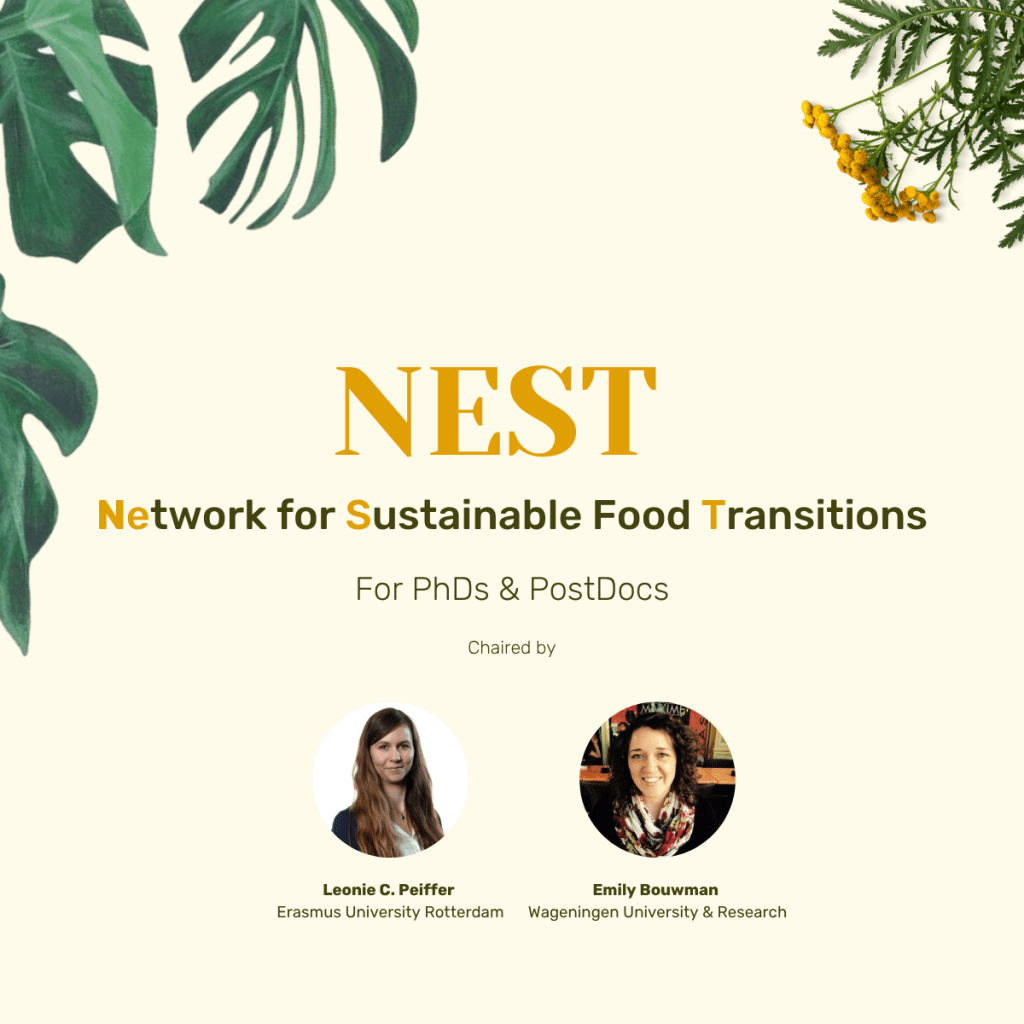
For more information about NEST, you can reach Leonie and Emily at: peiffer@eshcc.eur.nl and emily.bouwman@wur.nl.
Or on LinkedIn at:
Cover art by: Ashkan Forouzani
Post by Jared Piazza

The PHAIR Animal Advocacy Conference 2025 is just around corner and we are very much looking forward to it.
The conference programme and full schedule (with list of titles and abstracts) are now available on the conference website (https://phair2025.co.uk/programme/). You will also find information about the venue and travel information on the website.
The conference opens on Wednesday July 2nd with a public talk from Professor Peter Singer from 6-7pm. The conference then runs from Thursday July 3rd – Saturday July 5th, with Keynote talks by Professor Christopher Hopwood (University of Zurich) and Brooke Haggerty (Executive Director at Faunalytics).
Don’t miss the main Networking Event on Thursday July 3rd at 7pm (at The Caves), generously supported by ProVeg International, and our canape event at the Conference centre directly after the keynote talk on Friday, generously supported by Bryant Research.
Connect with us on Instagram @phair_society or Facebook @AnimalAdvocacyConference for photo and video updates throughout the conference and let’s use #PHAIR2025 across all platforms.


We thank ProVeg International, Bryant Research, Beyond Carnism, Animal Think Tank, Animal Ethics, and Food System Research Fund for their generous support! The PHAIR Animal Advocacy Conference 2025 would not be possible without them.

Faunalytics is excited to host their fourth annual remote symposium, Fauna Connections, for animal advocates on September 18, 2025 (tentatively 12pm-5:30pm EDT).
They invite academics and scientists from the social and behavioral sciences, or related disciplines, to submit a presentation abstract focusing on a synthesis of research. They are particularly interested in comprehensive talks, such as expert overviews (think of it as a mini-lecture you can give to advocates), that provide a deeper understanding of topics relevant to animal advocacy.
For more information and submission guidlines: https://faunalytics.org/fauna-connections. Applications for presentations are due by June 20th.
If you are interested, please apply! And please share this opportunity with anyone you believe would be interested in presenting at this symposium. Thank you so much!
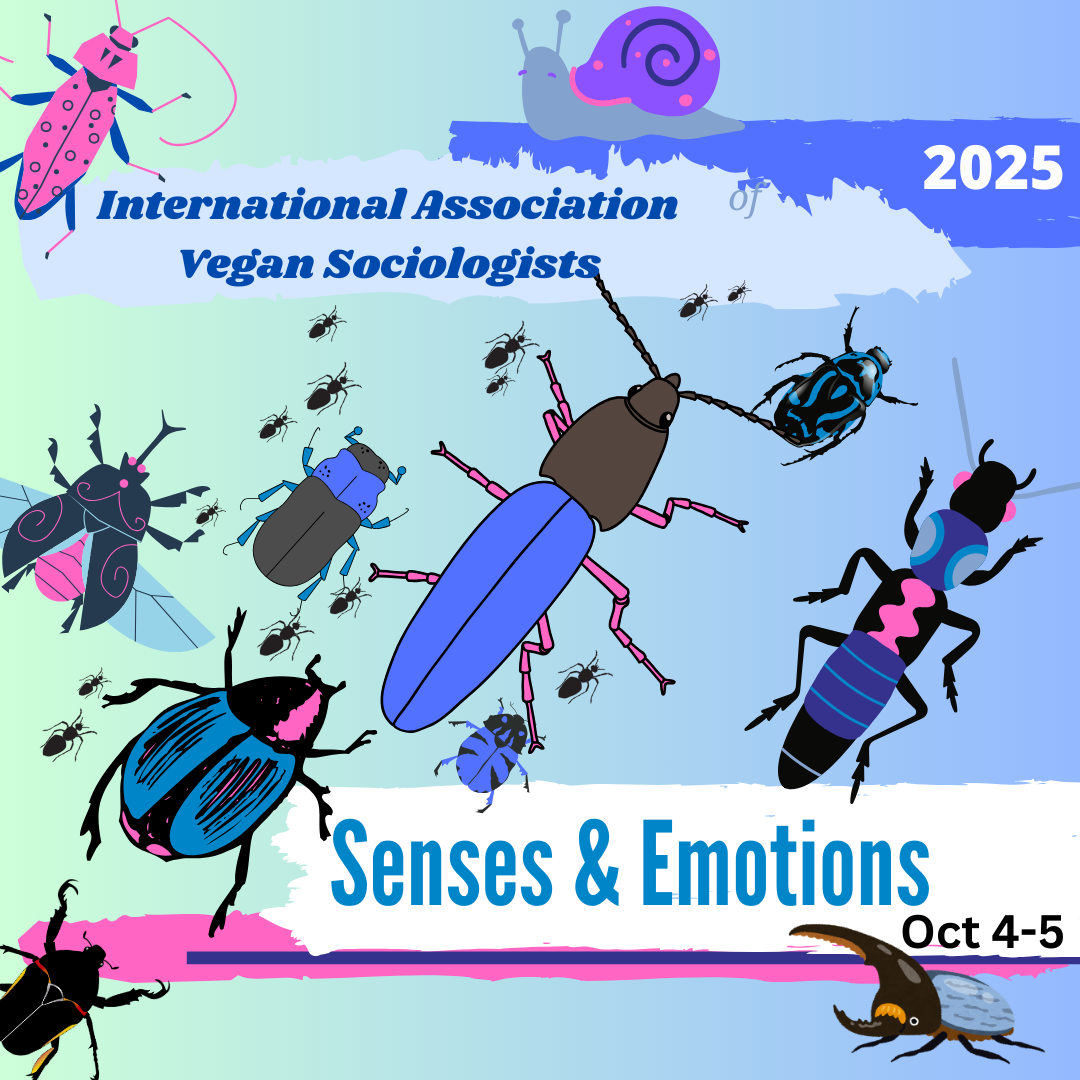
The International Association of Vegan Sociologists is welcoming submissions for individual presentations or panels for their 2025 annual online meeting “Senses & Emotions”, Oct 4-5, 2025.
Call for Paper Deadline: May 31, 2025
The 2025 IAVS annual meeting will showcase research related to veganism, animal rights, and sociological theories of emotions/senses. Participants are invited to consider how emotions and sensory experiences are integral to understanding and challenging nonhuman animal exploitation.
Proposals and queries should be sent to info@vegansociology.com by 31st May 2025. Submission guidelines and further information can be found on the conference webpage: https://www.vegansociology.com/conference/
Potential topics include (but are not limited to):
- Nonhuman animals as minded, feeling beings: how are animals’ emotions or sensory experiences minimised or acknowledged in society and/or vegan sociology research?
- Veganism, activism and emotional labour: How do activists navigate the emotions involved in advocating for other animals? What role does emotional labour play in vegan activism?
- Socialisation of emotions & animal exploitation: How are emotional norms or ‘rules’ around nonhuman animals socialised in ways that challenge or support vegan ways of being?
- Sensory experiences and the Body: how can vegan sociology help us to explore human and nonhuman animals’ felt experiences of the social world?
- Vegan Sociological perspectives on particular emotions: e.g. how might explorations of disgust, desire, grief, joy, sadness further our work for nonhuman animals
- Innovative research methods for exploring sensory elements of the multispecies social world: e.g. Emotional/Sensory mapping, visual, auditory, tactile, olfactory methods
- Representations of nonhuman animal emotions: ‘happy’ exploited animals, suicide food, attempts to build empathy
- Digital emotions and online vegan communities
- Intersections of species, race, gender, and emotional politics
Time to Register
Join us in Edinburgh for the PHAIR Animal Advocacy Conference, July 2–5, 2025!
There’s only ONE WEEK left to register at early bird price. Or support our work by buying a Supporter ticket! Don’t miss the opportunity and complete your registration now: https://phair2025.co.uk/register/
Public Lecture by Peter Singer

The conference begins with an in-person, public talk by Peter Singer (July 2, 6-7pm). RESERVE your seat HERE!
Journalists have bestowed the tag of “world’s most influential living philosopher” on Peter Singer. He was Ira W. DeCamp Professor of Bioethics in the University Center for Human Values at Princeton University from 1999-2024, where he now holds the rank of Emeritus Professor of Bioethics.
Singer first became well-known internationally after the publication of Animal Liberation in 1975. Some of his other books are: Practical Ethics, The Expanding Circle, Rethinking Life and Death, Pushing Time Away, The Life You Can Save, Ethics in the Real World, Why Vegan?, Animal Liberation Now, and, most recently, The Buddhist and the Ethicist.
In 2012, Singer was made a Companion of the Order of Australia, the country’s highest civilian honour. In 2021 he was awarded the Berggruen Prize for Philosophy and Culture, and in 2023, the Frontiers of Knowledge Prize for the Humanities, from the Spanish BBVA Foundation.

Social Event: Ceilidh with Live Music
On Thursday evening, we will host a Ceilidh (with live Scottish band) at The Caves. This evening will provide the perfect networking opportunity in an informal and inspiring setting, while enjoying drinks and tasty plant-based food. More details will follow.
Book your Accommodation
Book your room at budget-friendly rates in the Holland House, located on the site of the conference where all the action is: https://phair2025.co.uk/accommodation/ Enter the code PHAIRALOC at time of booking to secure your room from the PHAIR reserved accommodation block.
Alternatively, you can stay on-site in 4 star university hotels The Scholar Hotel or The Scott Hotel with a discount using the code PHAIR25.
Keynote Speakers
Brooke Haggerty, Executive Director of Faunalytics

Chris Hopwood, Professor at the University of Zurich & Editor-in-Chief of PHAIR

We are pleased to welcome many esteemed colleagues and speakers who will be delivering a diverse range of symposia, talks and workshops. Our conference website will be updated regularly when more information becomes available.
Cover photo credit: Jo-Anne McArthur / We Animals Media

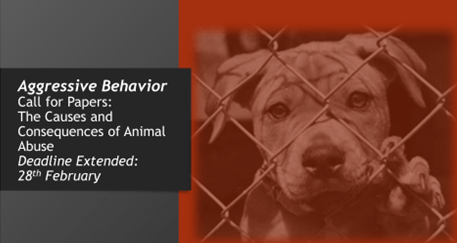
The journal Aggressive Behavior is currently receiving papers for a Special Edition: The Causes and Consequences of Animal Abuse, guest edited by Emma Alleyne. This is a fantastic opportunity to curate some of the latest theoretical and empirical papers that capture the current understanding of animal abuse where nonhuman animals are at the centre of the research question.
The journal welcomes fresh theoretical contributions and rigorously designed empirical papers for consideration in this Special Edition. For more details and submission guidelines: Aggressive Behavior: Call for Papers – The Causes and Consequences of Animal Abuse
Submission deadline extended: Friday, 28 February 2025
Please send inquiries to the Guest Editor, Emma Alleyne (e.k.a.alleyne@kent.ac.uk).

What is the study about? Victoria (Vicky) Simpson, PhD candidate at Lancaster University, is looking for vegan and vegetarian children ages 9- to 16-years to take part in an interview study exploring their experiences at school.
Parents: How to get in touch? If you are a parent of a vegan or vegetarian child in this age range, who might be interested in participating, please contact Vicky at v.a.simpson@lancaster.ac.uk
If you would like more information about the study, please get in touch as well. The study was ethically approved by Lancaster University’s FST Ethics Committee.
What is involved? The study consists of two 30-minute interviews conducted online. We will ask children to talk about their vegan or vegetarian identity, how this affects their experiences at school, and ask them to consider what their “perfect day” at school might look like.
Benefits to the child and school: Each child will be compensated with a £10 e-voucher. Their school will be entered into a prize draw for a £30 book token voucher.
Contact: Vicky Simpson at v.a.simpson@lancaster.ac.uk
Cover photo credit: Isabella Fischer
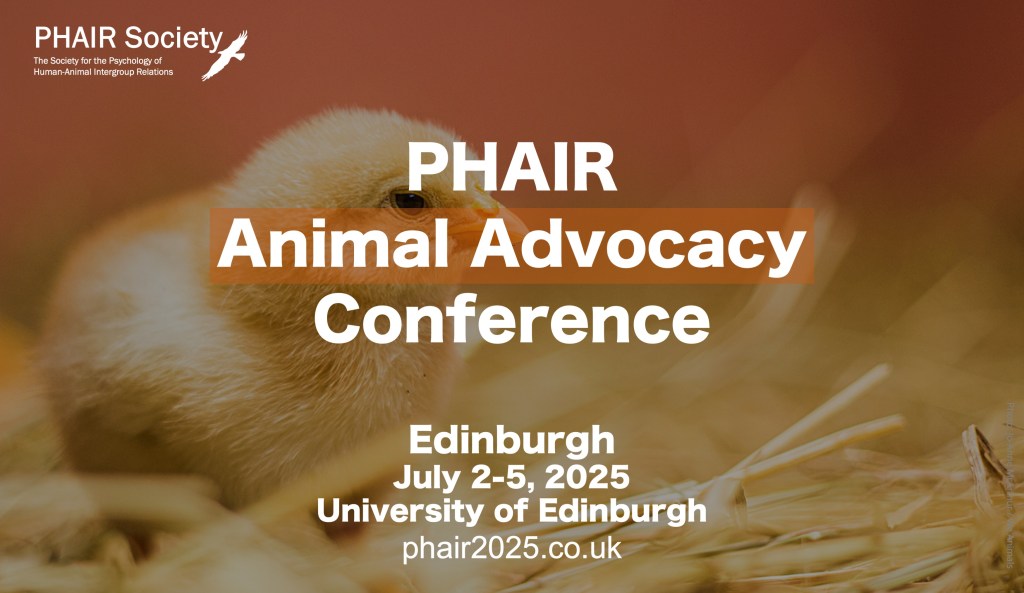
We are excited to announce the 2025 edition of the PHAIR Animal Advocacy Conference.
The conference will take place July 2–5, 2025 at Pollock Halls at the University of Edinburgh, in Edinburgh, Scotland. The conference begins with a public talk by Peter Singer held on July 2, and the main programme runs July 3–5.
The conference brings together researchers from social and behavioural sciences, and animal activists and advocates from around the world. We are interested in research on a range of topics relevant to animal advocacy including how we think about and relate to non-human animals, dietary choices and veganism, and effective approaches to animal advocacy.
The call for presentation submissions will be announced in November.
For more information and updates: phair2025.co.uk

Authors: Nora Bennigstad, Hank Rothgerber, & Jonas Kunst (2024)
Link to the paper (Open Access)
What’s the article about? (At a glance)
Meat-animal dissociation is when people fail to ‘see’ animals in meat or suppress thoughts about the animal origins of meat. In this PHAIR article, Bennigstad et al. (2024) distinguish between two types of meat-animal dissociation:
(1) active dissociation, where a person actively suppresses thoughts about the animal origins of meat (e.g., when an animal reminder is present);
(2) passive dissociation, where a person fails to think about the animal origins of meat when interacting with meat (e.g., because a product is familiar or habitually eaten).
The authors developed a scale that reliably distinguishes between the two forms of dissociation (e.g., active item: “I actively avoid meat that visibly reminds me of an animal”; passive item: “Animals rarely come to mind when I eat meat”) (Study 1). They found that both active and passive forms of dissociation are stable (Study 2); and explored active and passive orientations among meat industry workers and general consumers (Study 3).
Implications for advocacy
It may be useful for advocates to distinguish between these two forms of dissociation when building interventions. Passive dissociation may be especially problematic for animal advocacy because it may be indicative of a habitual relationship with meat. Indeed, Bennigstad et al. found that passive dissociation had a consistent positive relationship with meat consumption (Study 1). Furthermore, passive dissociation increased with time spent working with meat (Study 3), which may highlight the role of habit in its maintenance.
By contrast, active dissociation may be a sign that a person is ambivalent about meat and open to reduction, since they are actively trying to suppress problematic thoughts about meat in their daily lives.
Part of the work of advocates is to increase the visibility of animals exploited for food. But an equally important effort may involve finding ways to bring consumers’ thoughts to animal exploitation when they interact with animal products.
PHAIR post by Jared Piazza

Cover photo by: Markus Spiske

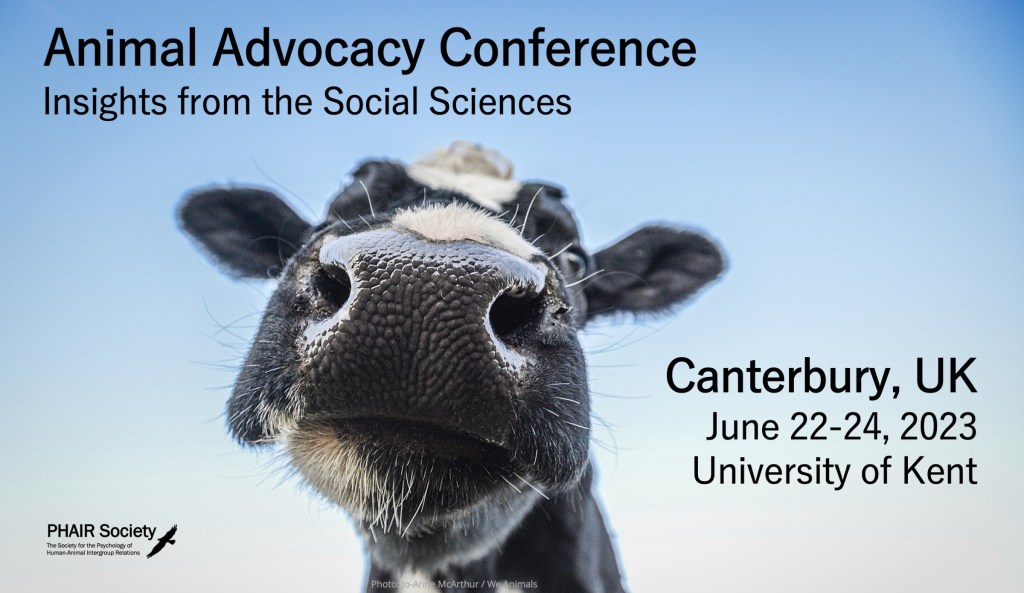
We are thrilled to announce the 2023 edition of the Animal Advocacy Conference: Insights from the Social Sciences.
The conference will take place June 22-24, 2023 at the University of Kent, UK.
We will bring together researchers from different fields in the social and behavioral sciences, and animal activists and advocates from around the world.
Learn about the latest ideas, findings and campaigns in the following domains:
- The psychological, social, and societal factors shaping how we perceive and think about animals, human-animal relations, and animal welfare and rights
- The impact of advocacy and activism strategies related to animal rights, veganism, meat reduction and reduction of other animal products (e.g., dairy, eggs)
- The social and behavioral science of animal cruelty, meat consumption (and other animal-product consumption), vegetarianism/veganism, and speciesism
- The connections and intersections between human-animal relations and human intergroup relations as well as between animal ethics and other social justice domains including environmentalism, feminism, and anti-racism
This conference uniquely bridges the gap between academic researchers and activists/professionals in the field of vegan and animal rights advocacy. The conference will create a stimulating environment where academics and activists/advocates exchange relevant knowledge, engage in lively debates, share their ideas, and can start collaborations.
Call for Submissions
The submission portal will open on November 2, 2022. We invite academic and research submissions in three different formats: Oral Presentation, Symposium, Poster Presentation.
For more information and updates: blogs.kent.ac.uk/animaladvocacy
Online: The psychology of meat avoiders
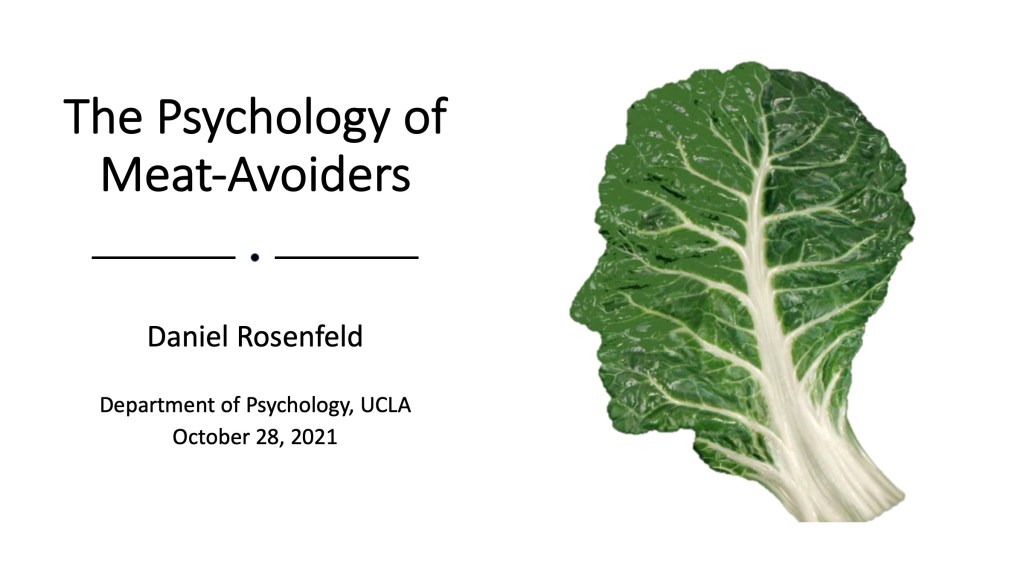
Daniel Rosenfeld gave the October talk in the PHAIR Society Speakers series on “The psychology of meat avoiders”. You can now watch the talk online.
Unfortunately, the first seconds of the talk were not recorded due to a technical glitch, but 99% of the talk is still there!
 PHAIR Society