Authors: Nora Bennigstad, Hank Rothgerber, & Jonas Kunst (2024)
Link to the paper (Open Access)
What’s the article about? (At a glance)
Meat-animal dissociation is when people fail to ‘see’ animals in meat or suppress thoughts about the animal origins of meat. In this PHAIR article, Bennigstad et al. (2024) distinguish between two types of meat-animal dissociation:
(1) active dissociation, where a person actively suppresses thoughts about the animal origins of meat (e.g., when an animal reminder is present);
(2) passive dissociation, where a person fails to think about the animal origins of meat when interacting with meat (e.g., because a product is familiar or habitually eaten).
The authors developed a scale that reliably distinguishes between the two forms of dissociation (e.g., active item: “I actively avoid meat that visibly reminds me of an animal”; passive item: “Animals rarely come to mind when I eat meat”) (Study 1). They found that both active and passive forms of dissociation are stable (Study 2); and explored active and passive orientations among meat industry workers and general consumers (Study 3).
Implications for advocacy
It may be useful for advocates to distinguish between these two forms of dissociation when building interventions. Passive dissociation may be especially problematic for animal advocacy because it may be indicative of a habitual relationship with meat. Indeed, Bennigstad et al. found that passive dissociation had a consistent positive relationship with meat consumption (Study 1). Furthermore, passive dissociation increased with time spent working with meat (Study 3), which may highlight the role of habit in its maintenance.
By contrast, active dissociation may be a sign that a person is ambivalent about meat and open to reduction, since they are actively trying to suppress problematic thoughts about meat in their daily lives.
Part of the work of advocates is to increase the visibility of animals exploited for food. But an equally important effort may involve finding ways to bring consumers’ thoughts to animal exploitation when they interact with animal products.
PHAIR post by Jared Piazza

Cover photo by: Markus Spiske

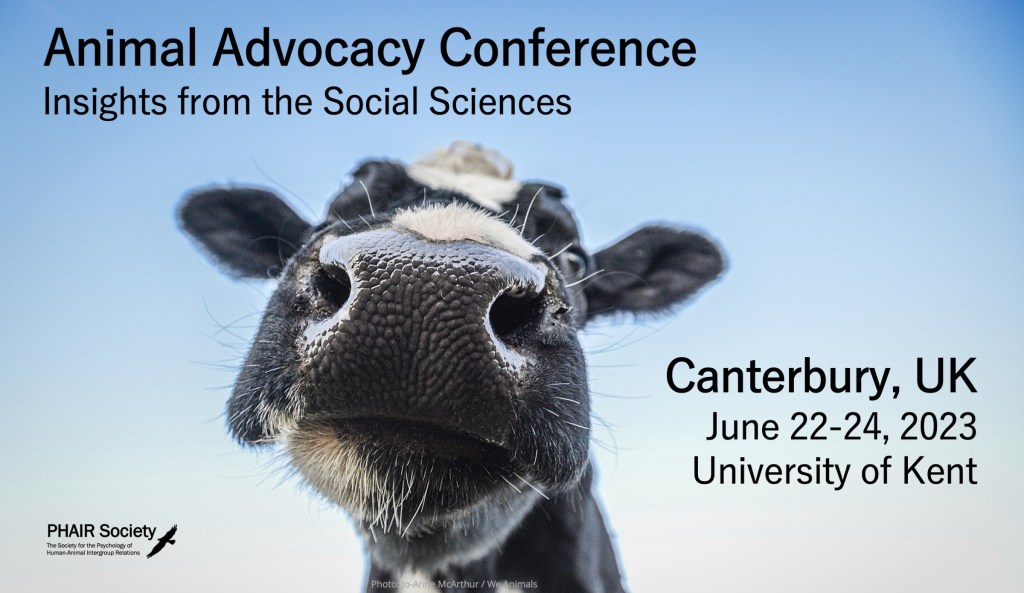
We are thrilled to announce the 2023 edition of the Animal Advocacy Conference: Insights from the Social Sciences.
The conference will take place June 22-24, 2023 at the University of Kent, UK.
We will bring together researchers from different fields in the social and behavioral sciences, and animal activists and advocates from around the world.
Learn about the latest ideas, findings and campaigns in the following domains:
- The psychological, social, and societal factors shaping how we perceive and think about animals, human-animal relations, and animal welfare and rights
- The impact of advocacy and activism strategies related to animal rights, veganism, meat reduction and reduction of other animal products (e.g., dairy, eggs)
- The social and behavioral science of animal cruelty, meat consumption (and other animal-product consumption), vegetarianism/veganism, and speciesism
- The connections and intersections between human-animal relations and human intergroup relations as well as between animal ethics and other social justice domains including environmentalism, feminism, and anti-racism
This conference uniquely bridges the gap between academic researchers and activists/professionals in the field of vegan and animal rights advocacy. The conference will create a stimulating environment where academics and activists/advocates exchange relevant knowledge, engage in lively debates, share their ideas, and can start collaborations.
Call for Submissions
The submission portal will open on November 2, 2022. We invite academic and research submissions in three different formats: Oral Presentation, Symposium, Poster Presentation.
For more information and updates: blogs.kent.ac.uk/animaladvocacy
Online: The psychology of meat avoiders
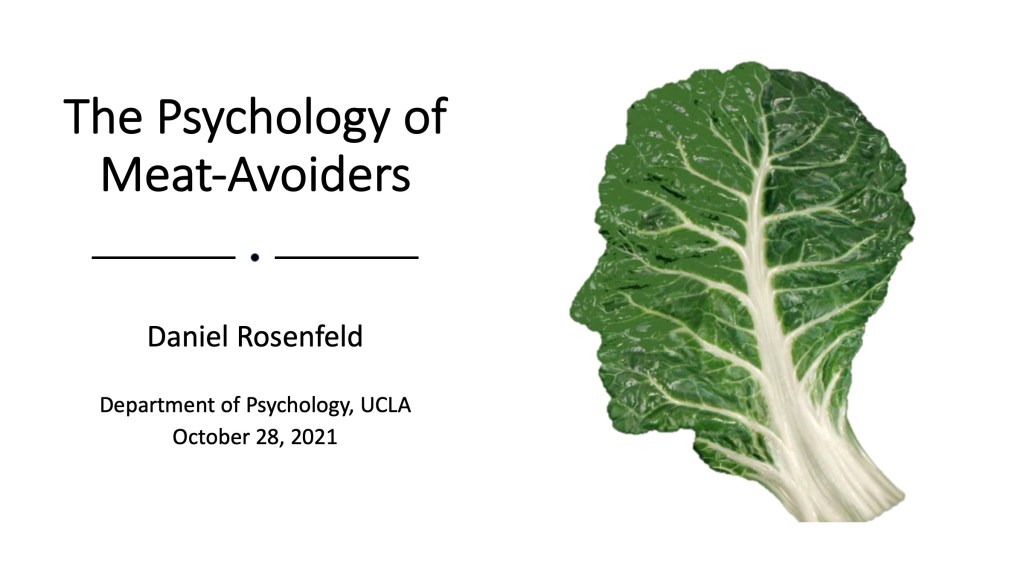
Daniel Rosenfeld gave the October talk in the PHAIR Society Speakers series on “The psychology of meat avoiders”. You can now watch the talk online.
Unfortunately, the first seconds of the talk were not recorded due to a technical glitch, but 99% of the talk is still there!
Online: Speciesism in everyday language
Stefan Leach gave the September talk in the PHAIR Society Speakers series on “Speciesism in Everyday Language”. You can watch the talk online:
Abstract
Speciesism, like other forms of prejudice, is thought to be underpinned by biased patterns of language use. Thus far, however, psychological science has largely focused on how speciesism is reflected in individuals’ thoughts as opposed to wider collective systems of meaning such as language. We present a large-scale quantitative test of speciesism by applying machine-learning methods (word embeddings) to billions of English words derived from conversation, film, books, and the internet. We found evidence of anthropocentric speciesism: words denoting concern (vs. indifference) and value (vs. valuelessness) were more closely associated with words denoting humans compared to most other animals. We also found evidence of companion animal speciesism: the same words were more closely associated with words denoting companion animals compared to other animals. The work paints a picture of speciesism as a pervasive collective truth that is evident in a naturally occurring expression of human psychology–everyday language
We have more talks coming up:
- Daniel Rosenfeld – October 28. The Psychology of Meat-Avoiders
- Catarina Possidónio – November 25. From Meat to Beets: Exploring Pathways to More Plant-forward Diets
Welcome
Welcome to the website of the Society for the Psychology of Human-Animal Intergroup Relations (PHAIR)! We will be announcing new activities, speakers, and debates from September 2021. To receive our updates, please send us your name and email address via phairsociety@gmail.com or subscribe to our website for updates.