
The International Association of Vegan Sociologists is holding their 2025 annual meeting “Senses & Emotions”, online Oct 4-5, 2025. Registration is free and you can get your ticket here: https://events.humanitix.com/iavs-2025-emotions-and-senses.
The 2025 IAVS annual meeting will showcase research related to veganism, animal rights, and sociological theories of emotions/senses. Participants are invited to consider how emotions and sensory experiences are integral to understanding and challenging nonhuman animal exploitation.
Faunalytics is excited to host their fourth annual remote symposium, Fauna Connections, for animal advocates on September 18, 2025 (tentatively 12pm-5:30pm EDT).
They invite academics and scientists from the social and behavioral sciences, or related disciplines, to submit a presentation abstract focusing on a synthesis of research. They are particularly interested in comprehensive talks, such as expert overviews (think of it as a mini-lecture you can give to advocates), that provide a deeper understanding of topics relevant to animal advocacy.
For more information and submission guidlines: https://faunalytics.org/fauna-connections. Applications for presentations are due by June 20th.
If you are interested, please apply! And please share this opportunity with anyone you believe would be interested in presenting at this symposium. Thank you so much!

Is participating in the app-based Veggie Challenge effective for reducing animal product consumption? And would it help to involve family and friends? Rosaly Severijns discusses the key findings and insights from her recently published research ‘Involving family and friends helps sustainable diets last longer’.
Could you give us a brief introduction about who you are and what you do, Rosaly?

I am a researcher interested in anything that has to do with climate beliefs and behaviours. During my PhD I studied how our social environment, so our family and friends, influences our consumption of meat and other animal products. The people around us play an important role in our decisions and habits. I recently started a postdoc at the University of Antwerp (Belgium) during which I hope to continue working on psychological and social processes behind meat consumption and other climate or health-related beliefs and behaviours. In my free time, I like to sing, read and travel 😊.
In your recently published research ‘Involving family and friends helps sustainable diets last longer’, you investigated the effects of the Veggie Challenge campaign. Can you briefly explain what the Veggie Challenge is and how you studied its impact?
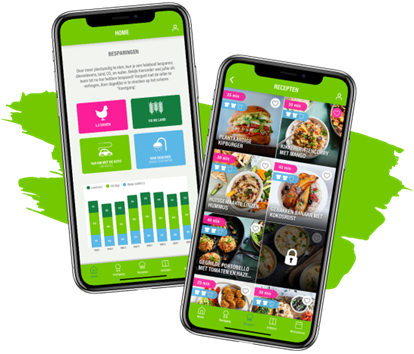
The Veggie Challenge is a campaign organized by the non-profit organization ProVeg International. During the challenge, people try to eat fewer animal products for 30 days with the support of an app. They can choose their own goal during the 30 days: start with meatless days or try a vegetarian or vegan diet. In the app they can find recipes and information about plant-based diets. They can also keep track of their behaviour (for instance, whether they succeeded at skipping a certain product or not), and receive feedback on how much land, water, emissions, and how many animals they are saving by eating a more plant-based diet. The app looks colourful and has gamification features, like quiz questions and rewards if you do well. In an extension of the app (Veggie Challenge Teams), participants can invite family and friends to their team and do the challenge together. They have a shared WhatsApp group and can see group-level activities and feedback.
We studied the effects of the challenge through a randomized controlled experiment. This means that we recruited individuals (about 1,200) and randomly assigned them to one of three groups: a group that did not take part in the Veggie Challenge (control group), a group that participated alone in the Veggie Challenge (individual intervention group) or a group that participated in the Veggie Challenge and were asked to invite others digitally and/or involve others in real life (social intervention group). We tracked all the participants over time up to three months after the intervention and compared their animal product consumption.
What were the key findings?
Our key findings were that initially, right after the intervention, both the individual and the social group consumed fewer animal products than the control group, a reduction of about 16-17% in animal product consumption. However, one and three months after the intervention the individual group bounced back to similar levels as the control group, while the effect of the social intervention group persisted.
We also found that people who still ate meat before the intervention were affected the most by the intervention. In line with this, the veggie challenge worked best to reduce meat consumption (25% reduction) rather than other animal products.
People want to maintain a coherent identity towards others and themselves. So when they tell people about their plans to reduce their meat consumption, it becomes more salient in their minds and they want to live up to that expectation.
Why is the social environment (involving friends and/or family) so important for reducing animal product consumption?
In general, the people around us influence our daily behaviours and habits. In particular for food, what we eat every day is rooted in negotiations with family, friends, or colleagues. Food is also linked to social events such as going out for dinner, or celebrating birthdays and holidays (e.g., Christmas). Others can also influence our beliefs and awareness about food, for example about the environmental or health impacts of meat consumption.
When people are already motivated to reduce meat consumption, like in our study, the social environment can play an important supporting role. Because we are dependent on others we eat with, having a non-supportive environment could pose a barrier to translating motivations into behaviour. In our study, we aimed to overcome this barrier by stimulating participants in the social intervention group to create a supportive environment and establish habits together with family and friends. While the initial effects were not larger than for the individual intervention group, we suspect that this supportive environment made the behaviour change last longer.
Another reason why involving others is important, is that telling others about our behavior change process or involving them makes it more ‘real’. People want to maintain a coherent identity towards others and themselves. So when they tell people about their plans to reduce their meat consumption, it becomes more salient in their minds and they want to live up to that expectation.
How can participants in the Veggie Challenge involve more family members and friends?
One way is to participate together with others using the app (Veggie Challenge Teams). Because this requires some effort from others, this would mostly work with people who are also motivated to reduce meat consumption, for example like-minded friends. That is why in our study we also encouraged participants to involve people in real life. This can be as simple as striking up a conversation about it. At home this can be done by telling household members about the challenge, about the plant-based/vegetarian meals you are eating, or even making them try those meals. One can also try to share recipes, struggles or thoughts about eating less animal products with friends or other acquaintances. People in our study reported that merely sharing their struggles or wins with others during the challenge made them more motivated.
The study only included individuals who already had an intention to reduce animal product consumption. Why did you decide to focus on this target group? Would you expect different results among people, especially omnivores, who are not initially interested?
That’s a good point. We focused on people with an intention to resemble real-life Veggie Challenge participants. In order for people to put the effort into starting such a challenge, they already need to have some motivation. I am not entirely sure about the possible results among less interested omnivores. On the one hand, there is a lot of room for them to eat fewer animal products, so even a small reduction due to the Veggie Challenge would be good. On the other hand, a lack of motivation may make people less inclined to download and continue with the app in the first place.
Regardless of the type of behaviour, challenges are better suited for individuals who are at least somewhat motivated. For people who lack motivation, an intervention that sparks initial motivation would be more suitable. This could be providing information on the impacts, appealing to emotions, encouraging discussions with motivated people, or changing the choice environment to introduce new habits (e.g., only offering plant-based meals or making those the cheapest, most logical options).
For this research project, you collaborated with a non-profit organization in the Netherlands (ProVeg Nederland). How did this collaboration start and how was this experience?
The collaboration started because I contacted them at the start of my PhD. I wanted to put my research in a real-life context and they happened to be looking for someone to study their Veggie Challenge. That’s how it became one of my PhD projects. I mostly worked with Pablo Moleman, who is in charge of research conducted at ProVeg Nederland. Our collaboration always went smoothly.
What are the key benefits of this collaboration?
The key benefit from a researcher’s point of view is the possibility to assess an impactful campaign that’s already publicly available. This increases the practical relevance of the research. Any person can download the Veggie Challenge right now. Rather than a hypothetical setting, the research is more applicable to real life.
Apart from that, a collaboration like this is beneficial to both sides: ProVeg wanted a robust experiment to test their campaign, but they did not have the time or resources for it. We at Hasselt University wanted to study practically relevant interventions and had the time and resources to do so. I would really recommend researchers to find collaborations with advocates or partners in the field.
Did you experience any significant challenges of working with an advocacy organization?
We did not run into any major issues. If I had to mention one thing, it would be that sometimes it was difficult to align practical goals with a strong research design. For example, for ProVeg it would have been ideal to know exactly what the effect is of participating in Veggie Challenge (Teams). However, a strong research design requires randomizing people into the groups, so they could not self-select in downloading the app and participating. Therefore, the intervention was an ‘encouragement’ to participate rather than actual participation. Luckily, ProVeg was always very open and flexible towards my research design recommendations.
In summary, uniting the research goals with the goals of an advocacy partner can take some time, but it is worth it.
What can organizations, food/vegan advocates, or policymakers learn from this research?
The main takeaway is that the social environment plays an important role in whether behaviour change happens and lasts. In our research, a quite simple encouragement to involve others already made the change last longer. It should be easy to implement this in other behaviour change campaigns. For example, an information campaign can easily include tips on how to seek support from others.
On a larger scale, I think behaviour change interventions are too often focused on individual behaviour change, ignoring that the social environment can be a huge barrier (or facilitator). Researchers and advocates should find ways to take this into account and overcome the barriers.
If you would like to get in touch with Rosaly, connect with her LinkedIn: https://www.linkedin.com/in/rosaly-severijns-phd-a4a119b4/
Cover photo credit: ProVeg
Interview and blog post by Georgia Harlow and Mia Patel. Editorial supervision by Kristof Dhont.


Extension of Submission Deadline
The closing date for proposal submissions to the PHAIR Animal Advocacy Conference 2025 has been extended with 1 week: 6 February 2025! (hard deadline without further extension)
The conference will take place July 2–5, 2025 at Pollock Halls at the University of Edinburgh, Scotland.
Submissions
We are inviting contributions in four different formats: Symposia, Standard Talks, Blitz Presentations, and Posters. The conference will be held in person and there is no capacity for online presentations.
The conference committee will make a final selection of presentations, posters, and symposia based on scientific quality, relevance, importance, and impact. Proposals that are not selected for oral presentations may be given the opportunity to present a poster instead.
You can read the call for proposals and the submission guidelines on the conference website: PHAIR2025.co.uk
The main themes of the conference are:
- The psychological, social, and societal factors shaping how we perceive and think about animals, human-animal relations, and animal welfare and rights.
- The impact of advocacy strategies related to animal rights, veganism, meat reduction and reduction of other animal products (e.g., dairy, eggs).
- The social and behavioural science of animal cruelty, meat consumption (and other animal-product consumption), vegetarianism/veganism, and speciesism.
- The connections and intersections between human-animal relations and human intergroup relations as well as between animal ethics and other social justice domains including environmentalism, feminism, anti-racism.
Early Bird Registration and Accommodation
Registrations have opened! Book your conference ticket now at early bird price: https://phair2025.co.uk/register/
Accommodation is available on the conference site, where all the action is: https://phair2025.co.uk/accommodation/
Book your room at budget-friendly rates in the Holland House. Enter the code PHAIRALOC at time of booking to secure your room from the PHAIR reserved accommodation block.
Alternatively, you can stay on-site in 4 star university hotels The Scholar Hotel or The Scott Hotel with a discount using the code PHAIR25.
Submission Deadline Reminder
The closing date for proposal submissions to the PHAIR Animal Advocacy Conference 2025 is January 30th 2025!
The conference will take place July 2–5, 2025 at Pollock Halls at the University of Edinburgh, Scotland.
Submissions
We are inviting contributions in four different formats: Symposia, Standard Talks, Blitz Presentations, and Posters. The conference will be held in person and there is no capacity for online presentations.
The conference committee will make a final selection of presentations, posters, and symposia based on scientific quality, relevance, importance, and impact. Proposals that are not selected for oral presentations may be given the opportunity to present a poster instead.
You can read the call for proposals and the submission guidelines on the conference website: PHAIR2025.co.uk
The main themes of the conference are:
- The psychological, social, and societal factors shaping how we perceive and think about animals, human-animal relations, and animal welfare and rights.
- The impact of advocacy strategies related to animal rights, veganism, meat reduction and reduction of other animal products (e.g., dairy, eggs).
- The social and behavioural science of animal cruelty, meat consumption (and other animal-product consumption), vegetarianism/veganism, and speciesism.
- The connections and intersections between human-animal relations and human intergroup relations as well as between animal ethics and other social justice domains including environmentalism, feminism, anti-racism.
Early Bird Registration and Accommodation
Registrations have opened! Book your conference ticket now at early bird price: https://phair2025.co.uk/register/
Accommodation is available on the conference site, where all the action is: https://phair2025.co.uk/accommodation/
Book your room at budget-friendly rates in the Holland House. Enter the code PHAIRALOC at time of booking to secure your room from the PHAIR reserved accommodation block.
Alternatively, you can stay on-site in 4 star university hotels The Scholar Hotel or The Scott Hotel with a discount using the code PHAIR25.


Are you a PhD student interested in the psychology of human-animal relations? Consider applying to the Summer School of the European Association of Social Psychology: https://blogs.kent.ac.uk/easp2025/
The Summer School is designed to bring together graduate students from across Europe (and beyond) for 10 days of immersive learning, to be held in Canterbury, UK, at the University of Kent from 20th – 31st July 2025.
The Human-Animal Relations workstream will focus on the social and moral psychology of human-animal relations and animal product consumption, and will be led by Kristof Dhont, Emma Alleyne, and Chris Hopwood.
We will explore the psychological and motivational factors that shape how people perceive and think about animals and will cover the psychology of speciesism, animal cruelty, and animal versus plant-based product consumption. We will also explore the impact of interventions and strategies related to animal abuse offending, prevention of animal cruelty, the reduction of animal product consumption, and support for animal welfare and rights. Throughout the sessions, we will highlight the theoretical and empirical overlap between research on human-animal relations and research in other social domains including human intergroup relations and interpersonal violence. We will consider questions such as:
- How do people perceive and think about animals as a social group?
- What motivates people to continue or reduce animal product consumption?
- How can we reduce exploitative attitudes and behaviours towards animals, including animal abuse offending, animal product consumption, and speciesism?
All students, regardless of thematic workstream, will also benefit from a dedicated series of additional events on “Methods, Meta-Science, and Mentorship”. Furthermore, there will be a variety of exciting social activities planned to complement the busy programme. These events are designed to offer students a chance to unwind, network, and build lasting connections in a more relaxed setting.
The application deadline is December 31st 2024, and full details on the Summer School and the application procedure can be found on the website: https://blogs.kent.ac.uk/easp2025/
Please share with interested parties, and if you have any questions please email easp2025@kent.ac.uk.
We are now welcoming submissions for PHAIR Animal Advocacy Conference 2025!
The conference will take place July 2–5, 2025 at Pollock Halls at the University of Edinburgh, Scotland.
We are inviting contributions in four different formats: 4-person Symposia, Standard Talks, Blitz Presentations, and Posters. The conference will be held in person and there is no capacity for online presentations.
The conference committee will make a final selection of presentations, posters, and symposia based on scientific quality, relevance, importance, and impact. Proposals that are not selected for oral presentations may be given the opportunity to present a poster instead.
The closing date for submissions is January 30th 2025.
You can read the call for proposals and the submission guidelines on the conference website: PHAIR2025.co.uk
All submissions should be related to one (or more) of the main themes of the conference:
- The psychological, social, and societal factors shaping how we perceive and think about animals, human-animal relations, and animal welfare and rights.
- The impact of advocacy strategies related to animal rights, veganism, meat reduction and reduction of other animal products (e.g., dairy, eggs).
- The social and behavioural science of animal cruelty, meat consumption (and other animal-product consumption), vegetarianism/veganism, and speciesism.
- The connections and intersections between human-animal relations and human intergroup relations as well as between animal ethics and other social justice domains including environmentalism, feminism, anti-racism.


The journal Aggressive Behavior is currently receiving papers for a Special Edition: The Causes and Consequences of Animal Abuse, guest edited by Emma Alleyne. This is a fantastic opportunity to curate some of the latest theoretical and empirical papers that capture the current understanding of animal abuse where nonhuman animals are at the centre of the research question.
The journal welcomes fresh theoretical contributions and rigorously designed empirical papers for consideration in this Special Edition. For more details and submission guidelines: Aggressive Behavior: Call for Papers – The Causes and Consequences of Animal Abuse
Submission deadline: Tuesday, 31 December 2024
Please send inquiries to the Guest Editor, Emma Alleyne (e.k.a.alleyne@kent.ac.uk).
Authors: Julie Pedersen & Steve Loughnan (2024)
Link to the paper (Open Access)
What’s the article about? (At a glance)
Might drawing consumers’ attention to the animal-bodily origins of dairy milk (e.g., its basis in cow lactation) and the potential for pathogen risk reduce consumer interest in dairy? Pedersen and Loughnan (2024) recently explored this question in a registered report published in PHAIR.
In Study 1, they had participants reflect on the bodily processes by which dairy cows lactate or digest their food. The lactation vignette emphasised the potential for “bacterial contamination”, whereas the digestion vignette emphasised the role of gut bacteria in the breaking down of grass. Participants indicated how disgusted they felt about consuming dairy milk and their willingness to consume it before and after the intervention. Relative to reading about digestion, thinking about cow lactation increased disgust towards dairy milk, which in turn reduced willingness to consume it.
In Study 2, a similar pre-post procedure was used, though the digestion condition was replaced with a neutral condition, where only baseline information about cows was presented. Participants indicated again how disgusted they felt about dairy milk, but the researchers also offered participants the opportunity to eat milk chocolate buttons to measure the intervention’s impact on dairy consumption. The lactation information, again, increased feelings of disgust towards dairy milk, but there was no difference in milk chocolate consumption (serving size) between the lactation and neutral conditions.
Together, the studies demonstrate how thoughts about the animal origins of dairy milk, linked to the bodily processes involved in mammalian lactation and pathogen risk, can momentarily reduce appetite for milk and a willingness to consume it. However, these momentary attitudinal effects did not translate into actual reduction, at least not in terms of eating milk chocolate.
Implications for advocacy
Studies have shown that pathogen-linked disgust can be a strong deterrent of food consumption (see previous PHAIR blog on meat disgust). The Humane League for example found that fish consumers were particularly troubled when learning about the potential for disease transmission within fish farms. One key direction for future work then is working out how these body and pathogen-linked concerns about dairy products can be harnessed to truly shift consumer decisions and increase the uptake of plant-based alternatives. Long-term changes in dairy consumption may require more personal and recurrent encounters with the unpalatable aspects of dairy production.
PHAIR post by Jared Piazza

Cover photo by Max Saeling

The deadline for submissions to the Animal Advocacy Conference 2023 is approaching fast! 😮
Don’t miss out on the opportunity to present your research and submit your proposal by December 20, 2022.
You can read the call for proposal and the submission guidelines on the conference website: https://blogs.kent.ac.uk/animaladvocacy/submissions/
…and you can take a sneak peek at some of the confirmed speakers: https://blogs.kent.ac.uk/animaladvocacy/speakers/
We are also delighted to announce that a limited number of travel grants will be awarded to graduate students of accepted proposals. More information on how to apply for travel grants will follow later.
About the Conference
The Animal Advocacy Conference brings together researchers from different fields in the social and behavioural sciences, and animal activists and advocates from around the world.
Learn about the latest ideas, findings, and campaigns in the following domains:
- The psychological, social, and societal factors shaping how we perceive and think about animals, human-animalrelations, and animal welfare and rights
- The impact of advocacy and activism strategies related to animal rights, veganism, meat reduction and reduction of other animal products (e.g., dairy, eggs)
- The social and behavioural science of animal cruelty, meat consumption (and other animal-product consumption), vegetarianism/veganism, and speciesism
- The connections and intersections between human-animal relations and human intergroup relations as well as between animal ethics and other social justice domains including environmentalism, feminism, and anti-racism
The conference program will include some of the world’s leading scholars and advocates in the field with exciting public keynote presentations, several symposia and sessions with research talks, a poster session, panel discussions and workshops. Most sessions will be in-person but we will also hold some sessions online.
We look forward to reading your submissions!
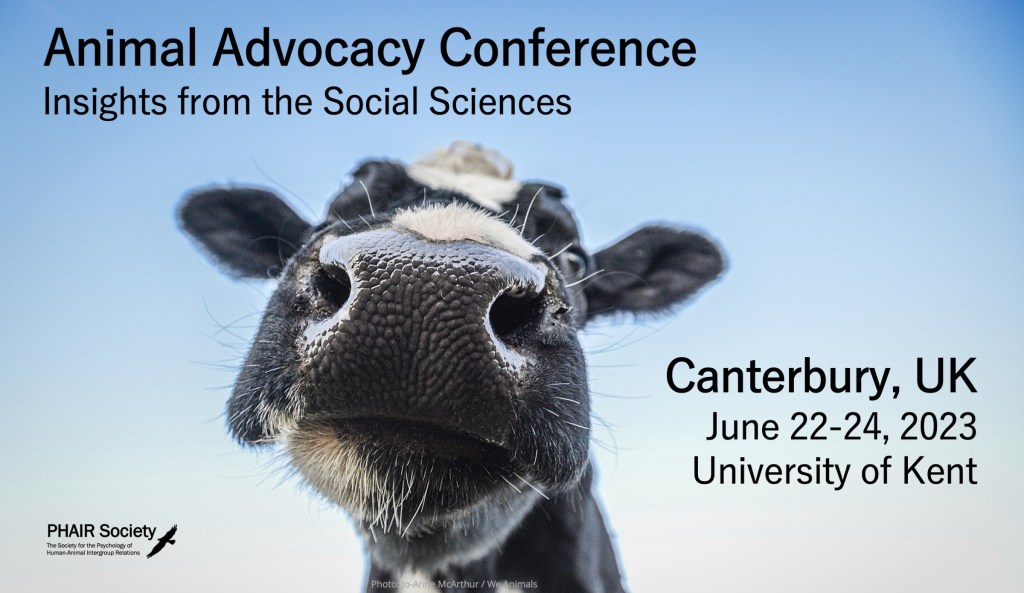
We are thrilled to announce the 2023 edition of the Animal Advocacy Conference: Insights from the Social Sciences.
The conference will take place June 22-24, 2023 at the University of Kent, UK.
We will bring together researchers from different fields in the social and behavioral sciences, and animal activists and advocates from around the world.
Learn about the latest ideas, findings and campaigns in the following domains:
- The psychological, social, and societal factors shaping how we perceive and think about animals, human-animal relations, and animal welfare and rights
- The impact of advocacy and activism strategies related to animal rights, veganism, meat reduction and reduction of other animal products (e.g., dairy, eggs)
- The social and behavioral science of animal cruelty, meat consumption (and other animal-product consumption), vegetarianism/veganism, and speciesism
- The connections and intersections between human-animal relations and human intergroup relations as well as between animal ethics and other social justice domains including environmentalism, feminism, and anti-racism
This conference uniquely bridges the gap between academic researchers and activists/professionals in the field of vegan and animal rights advocacy. The conference will create a stimulating environment where academics and activists/advocates exchange relevant knowledge, engage in lively debates, share their ideas, and can start collaborations.
Call for Submissions
The submission portal will open on November 2, 2022. We invite academic and research submissions in three different formats: Oral Presentation, Symposium, Poster Presentation.
For more information and updates: blogs.kent.ac.uk/animaladvocacy
Call for proposals for Faunalytics Research Day
Faunalytics will host a remote symposium for animal advocates on September 8, 2022. They invite academics and scientists from the social and behavioral sciences, or related disciplines, to submit a presentation abstract of original research that discusses the real-life implications and recommendations of such data for animal advocates in any of the four areas: farmed animals, companion animals, wild animals, and animals used in science.
Examples of topics related to this theme include, but are not limited to, meat-reduction interventions, how people think about animals, barriers and challenges in transitioning to veganism, how to build coalitions with other social movements, how to influence policy-makers, how to transition to animal-free methods in science, the impact of outdoor cats on wildlife, how to improve adoption rates for shelter animals, and the impact of animal rights protests.
You can learn more and apply here: https://faunalytics.org/fauna-connections-using-data-to-help-animals
Applications for presentations are due by July 10.
 PHAIR Society