
An interview with Sarah Kunze about her recent open-access publication on the Dairy Paradox published in Food Ethics. We discuss why dairy is often neglected by consumers as an ethically problematic food, how consumers rationalise its consumption and how advocates might address this moral blind spot.
Sarah, could you briefly introduce yourself?
I’m Sarah Kunze (she/they), currently based in the Netherlands, close to a forest and Wageningen University. I study “more-than-human” paradoxes around food and agriculture. I’m affiliated with two departments, Philosophy and Cultural Geography. For my PhD research, I study the role of alternative protein technologies in my project: ‘Paradoxes of Cellular Agricultures’.
My background is in translation studies, linguistics, and science communication. More recently, I’ve been working in areas such as food and care ethics, feminist methodologies, playful systems thinking, and post-growth worlds. Beyond the academic world, I love spending time in the forest, cooking and sharing food, hiking, drawing, making things and odd objects.

Contact Email: sarah.kunze@wur.nl
LinkedIn: https://www.linkedin.com/in/sarah-kunze-248a70199/
Affiliation: Wageningen University, Philosophy and Cultural Geography
Favourite animal: Frogs (currently)
You have a new paper out, co-authored with Bernice Bovenkerk and Daniel Fischer, titled “Beyond Natural, Normal, Necessary, Nice: Introducing ‘Neglectable’ as a Distinct Coping Strategy for the Dairy Paradox”. Your research focuses on dairy consumption. Why did you choose this focus? What drew you to this topic?
When you start thinking about it, milk quickly becomes one of the weirder animal-sourced foods of them all. Which other mammal consumes the milk of a different mammal? And at the same time, consuming cows’ milk continues to carry this natural, clean, white, healthy, nutritious image for growing strong bones and muscles, and more. Dairy seemed like a refreshing, yet absurd topic to dive into, and Bernice and Daniel were intrigued, too. So that is what we decided to look into for my Master’s thesis back in 2022 – asking whether there was also a “dairy paradox” beyond the well-known “meat paradox“.
Since then, we were happy to see that there is more attention given to the topic, including excellent work by Maria Ioannidou on dairy-product rationalisation, and Chelsea Davies and Samantha Stanley, Devon Docherty and Carol Jasper on the cheese paradox, whose research you have covered previously in the PHAIR blog.
Your research used focus group sessions to gather qualitative data. Can you briefly walk us through what was involved?
Bringing young people in Wageningen together around one table to discuss a topic that has not been paid much attention seemed like a good starting point. Questioning the role of meat in future diets is a common topic in the Netherlands. Dairy, milk and especially cheese, however, have a different image for Dutch consumers.
We were interested in the tensions young people face around dairy consumption and asked Dutch students from Wageningen University about their perspectives. This included questions on their favourite breakfast, how they choose which animal products to (not) eat, their main associations with dairy compared to meat, and what they think of the possibility of producing milk proteins in bioreactors instead of using cows. In the summer of 2022, we held three focus groups, in the same format, with six participants each, most of whom regularly consume dairy products.
In the paper, your team shows that dairy consumers justify consumption of dairy with 5Ns. Our readers are quite familiar with the 4Ns of meat-consumption justification. What is the fifth N, and how does it manifest in relation to dairy consumption?
We found that the justifications for dairy consumption were not all covered by the justifications we know for meat. The 4Ns (normal, natural, necessary, and nice) were also used for dairy. However, we also found that dairy was often framed more positively and, in contrast, involved a far more romanticised and cleaner image compared to meat. Furthermore, from our data analysis, a new N emerged. Dairy was considered ‘neglectable’ in several ways – for example, participants reasoned that dairy is too hard to avoid (“Dairy is in almost every product: cookies, in chips, like what? Milk powder…“) or less important as a moral issue than meat (“With meat, animals are slaughtered – killed. And everything that happens to them. With dairy this is not the case. The animals can still have a good life.”). In the paper, we distinguish neglectable on four different levels: product, cow, human, and system levels.
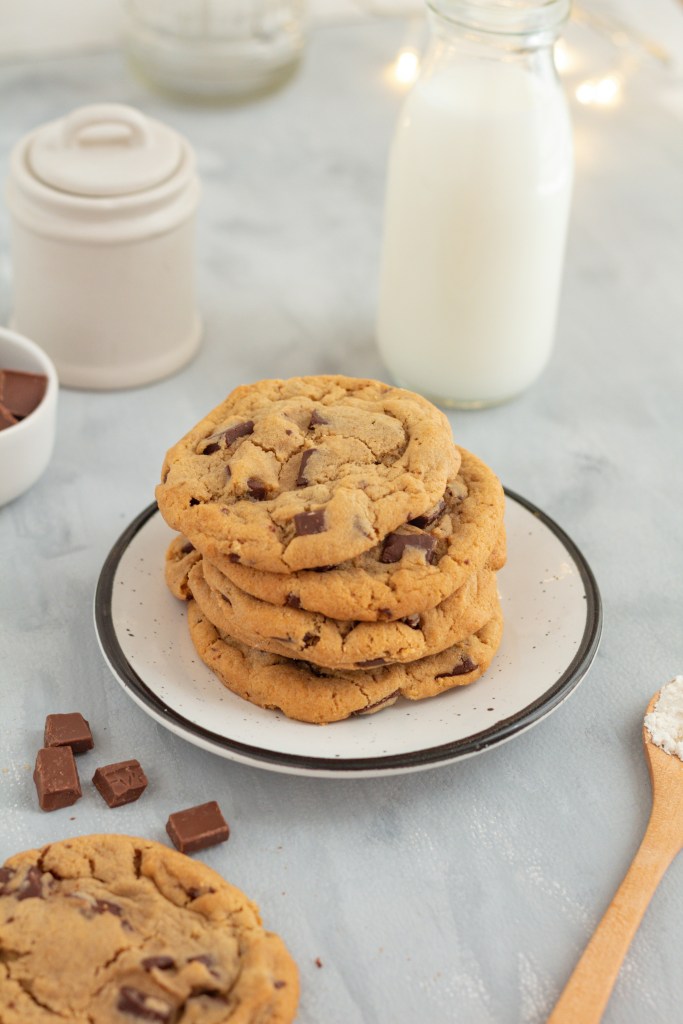
The positive image of dairy was one of the main reasons why it seemed to be more neglectable than meat. Furthermore, dairy tends to be even more deeply embedded in contemporary food systems than meat and is therefore neglectable as it would be too hard to address (“It is a lot. I mean, how? Just imagine: You have to do it all? You’ll have to change everything in the Netherlands…“). Similarly, participants in our study claimed that dairy is neglectable as it is often only consumed in smaller quantities and might not have ‘enough impact’ to leave out of one’s diet, especially compared to meat.
Why might dairy be easier for consumers to “neglect” than meat? What makes dairy more neglectable than meat?
Participants shared that dairy is ‘only an animal product’ to them – no animals seem to be harmed or killed for it. It is still a common story that cows have a ‘good life’ and ‘give milk anyway,’ which helps rationalise using milk for human consumption. The perceived distance between consumption and ‘direct harm’ to the animal, the perceived lower environmental impact of dairy compared to meat, and the widely promoted health benefits of dairy combine to create a strong recipe for considering dairy as neglectable, compared to meat.
Yet, several practices of dairy farming are not commonly known or part of popular discourse that challenge how neglectable this all can be. For example, dairy farming is the 2nd largest greenhouse gas emitter in animal agriculture; cows are artificially inseminated every year so that they continue to produce milk for their calves, who they are separated from early on; the calves are fed by feeding machines and sold for meat if they are male; cows who are not ‘productive enough’ are sent to slaughter. In contrast to dominant narratives about dairy, there is no cow’s milk without meat. Indeed, knowledge of this fact can challenge the meaning of “moral vegetarianism” altogether.
In the paper, you talk about different “coping strategies” that dairy consumers engage in. Briefly, what are these “dairy-specific coping strategies”, how do they relate to cognitive dissonance, and can you give us some examples from each category?
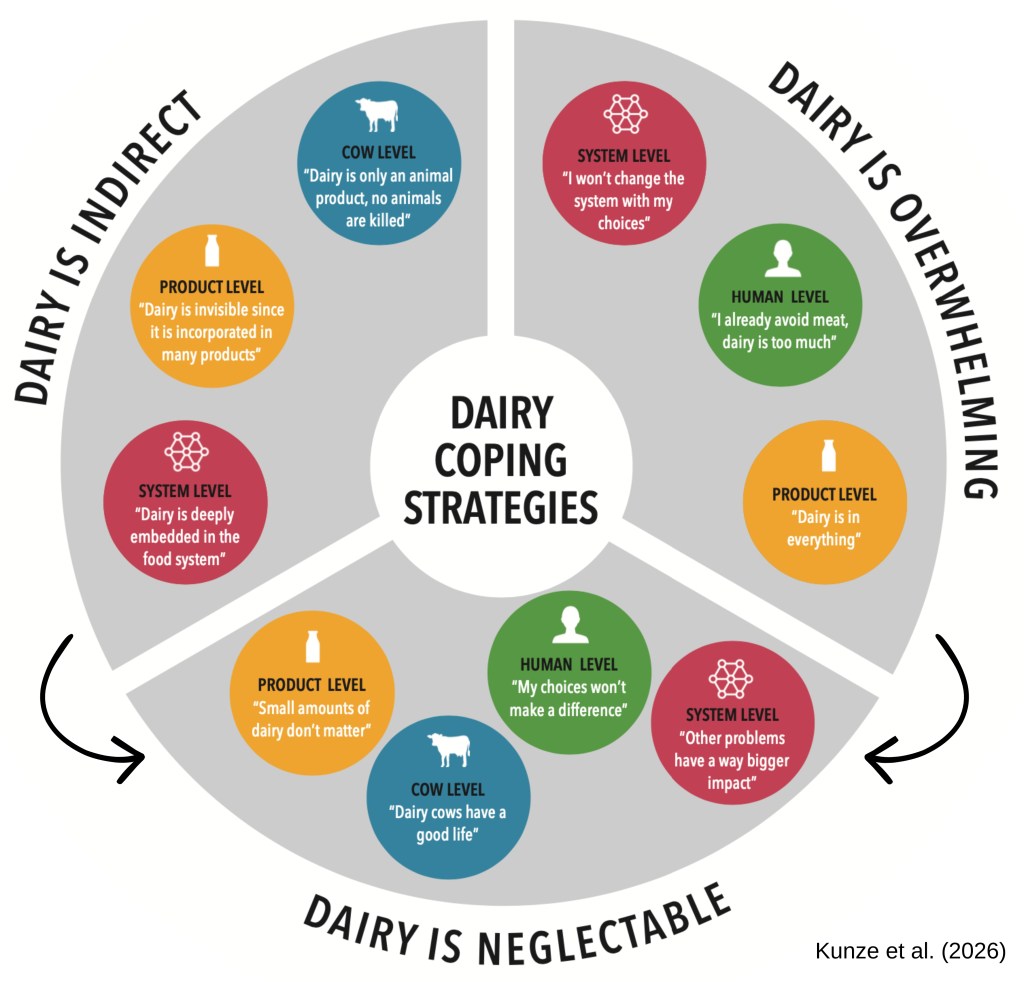
As depicted in the above image, we observed three different dairy-specific coping strategies.
- Dairy is indirect: Milk seems less direct than meat, for example, its in cakes that you don’t notice directly unless you think about it. Similarly, cows are not directly slaughtered for dairy. Cows produce milk while they are alive, yet cows are also slaughtered when their milk efficiency decreases; somehow, that is merely seen as ‘part of the industry’ and not ‘directly’ connected to milk production.
- Dairy is overwhelming: Participants also shared that there are already so many things to consider, and compared to meat, dairy seemed like a step too far, too hard to leave out of their diets. Milk seems more overwhelming, as there are often only small quantities of milk powder in a lot of products, such as potato chips (crisps).
- Dairy is neglectable: As a result of the way dairy seems more indirect and overwhelming, we found that participants conclude that it is ‘neglectable’ to them. The cognitive dissonance that might occur around dairy consumption is then eliminated and allows most people to continue to consume dairy and cheese in all its varieties.
What are some key takeaways from this research that you think could help inform animal advocacy work being done on the topic of dairy consumption? Are there unique challenges that advocates and organisations might face when addressing dairy-product consumption as opposed to, say, meat consumption?
Four years later, since we did this study, my views have developed a lot. I remember when I started looking into questions around dairy, I felt quite overwhelmed (much like my participants), as the topic seemed to be so hopeless to change. However, the absurd and weird aspects of it are what keep me going. I see lots of parallels in thinking about dairy with other forms of oppression and other struggles. I think diving into strange stories of “more-than-human” realities can help question and challenge what we consider to be normal (or neglectable ;).
Practically speaking, there are still lots of silences around the dairy industry, and the industry has been very successful in propagating the image of dairy as kind, clean, natural and healthy. Animal advocates, therefore, need to dispel the stories of dairy as being unproblematic (e.g., see Mercy For Animals’ “Got Misery?” campaign) and to think carefully about ways to deal with how dairy is in so many products that it can seem overwhelming to let go of it.
One of the ways to compensate for these overwhelming feelings is to offer very practical alternatives. However, as I continued studying the field of alternatives in the past years, I found that merely more investment in alternative products does not, by default, lead to desired outcomes. Within current dominant growth paradigms, merely adding alternative products to the market is not enough to generate change for the lives of animals, without also addressing issues related to overconsumption and overproduction of animal protein. In technology studies, this is also known as the ‘Jevons paradox’ or rebound effect. This means that alternatives alone do not result in the desired change in animal agriculture – they only add new (vegan) products to the market on top of a growing livestock industry.
For my further research, I am diving into these stories of paradoxes in food-system transformations that go in several directions. While zooming in on more specific products and places, from meat to dairy and more, I also think it is crucial to consider the system-level perspectives and, therefore, a more intersectional approach to animal advocacy.
Papers by Sarah Kunze
Kunze, S., Bovenkerk, B., & Fischer, D. (2026). Beyond natural, normal, necessary, nice: Introducing “neglectable” as a distinct coping strategy for the dairy paradox. Food Ethics, 11(28). https://doi.org/10.1007/s41055-026-00214-3
Hase Ueta, M., Robaey, Z., & Kunze, S. (2025). The horizons of change: Between past memories and future imaginations in sustainable food transitions. Journal of Rural Studies, 119, 103792. https://www.sciencedirect.com/science/article/pii/S0743016725002335
Blog and interview questions by Jared Piazza for PHAIR
Cover photo by Austin Santaniello

