
An interview with Seth Ariel Green, author of the new paper, “Meaningfully reducing consumption of meat and animal products is an unsolved problem: A meta-analysis“, co-authored with Benny Smith and Maya Mathur. Seth discusses with us findings from his recent meta-analysis that focused on the most rigorous set of psychology-based intervention studies conducted to date on meat and animal product reduction. Seth explains what his findings mean for the field and where we should be placing our attention and efforts going forward.
Seth, could you briefly introduce yourself?
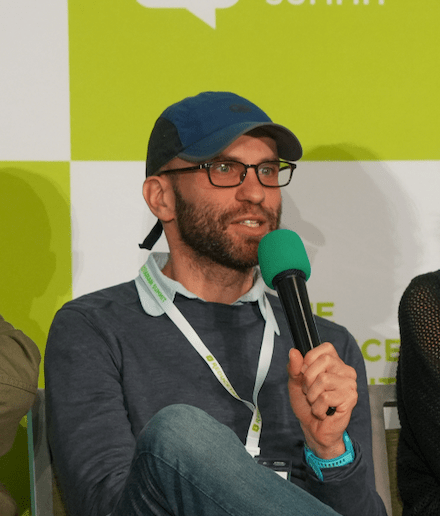
I am a research scientist at the Humane and Sustainable Food Lab at Stanford University. I write about the field and research into meat reduction at https://regressiontothemeat.substack.com/. I’m a social scientist by training and I specialise in meta-analysis. I live in Brooklyn and my main non-work thing right now is rock climbing. In terms of favourite animal: I’m fond of dholes and manta rays. If you like podcasts, I recently discussed this project and few others with James Ozden on How I learned to Love Shrimp.
In your recent paper, your team presents a meta-analysis of research that has tested interventions aimed at reducing meat and animal product consumption. Compared to previous meta-analyses of meat-reduction interventions (e.g., Mathur et al., 2021), your meta-analysis applied quite strict inclusion criteria. Can you explain what these inclusion criteria were and why you narrowed your focus in this way?
It’s often interesting and revealing to distil a literature down to the few dozen “best” papers and see what they have to say (and to note how few of them there are!). This approach of focusing on the most rigorous studies proved fruitful in a previous analysis of the contact hypothesis. I figured we could get a nice paper out of applying it to reducing meat consumption.
I don’t agree that our inclusion criteria are “quite strict.” We required studies to (a) include at least 25 subjects in both treatment and control; (b) apply randomisation; and (c) include measures of meat consumption at least 24 hours after the treatment begins. I think that these criteria represent a pretty low bar. The fact that only 35 papers (comprising 41 studies and 112 interventions) cleared them is our headline finding.
The upside of that scarcity is that if you have a theory for reducing meat consumption and you meet these criteria, there’s a pretty good chance that yours will be the most rigorous study on your question ever written. (See Simonsohn, Simmons, and Nelson, “Above averaging in literature reviews” for more on the approach to meta-analysis we took.)
In the end, what types of intervention studies were included in your analysis, how many, and what were some of the key findings?
The interventions that we included in the analysis fell into four categories: 1) persuasion efforts (and its three sub-categories of animal welfare, environmental, and health appeals), 2) choice architecture (moving items around on a menu or making it more difficult to serve yourself fish sauce by placing a hole in the serving spoon), 3) psychology (typically norms appeals, but also response inhibition training), and 4) combinations of persuasion and psychology. Some of the papers included multiple categories of interventions that were contrasted against each other and some interventions combined multiple categories together (e.g., health and environmental reasons for cutting back on meat consumption).
Here’s a table of our main results (SMD is “standardised mean difference”):
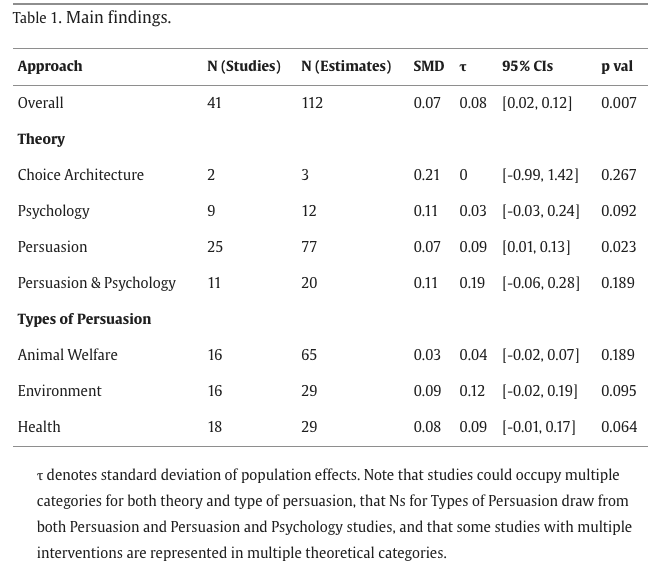
The key takeaway here is that the overall effect size is an SMD = 0.07, which means that on average, interventions reduced meat consumption by 7/100ths of a standard deviation. This is generally considered a small effect. It’s not easy to translate this into, e.g., portion reductions, but in general, think reductions on the order of 1-2 percentage points. Interested readers can check out our summary of the results at the Effective Altruism Forum for more details.
What do you see as the key take-away messages from your analysis? Were there particular research designs or intervention types largely absent or excluded from analysis and thus in need of further empirical attention?
Note that these are my key takeaways rather than the team’s. The first takeaway is that reducing meat consumption is hard! Meat consumption is rising almost everywhere and has been for decades. If there were some very effective, very generalisable intervention for reducing it, it would be headline news.
Second, research in our field is getting better over time. Most of the papers we looked at were published from 2020 to 2023 (our cutoff date was December 2023). So, I think we’re going to make more headway going forward than we have to date.
Third, there is a pretty good chance, if you are a researcher, to be the first to ever run a rigorous Randomised Controlled Trial with a long-term measurement strategy on a wide variety of questions related to meat consumption. I think that’s a great opportunity.
In terms of future directions, I’d like to see more evaluations of compound interventions (e.g., watch Dominion today, talk about the movie next week with your fellow viewers), narrative-based media interventions (e.g., watch Babe), and interventions that offer direct, positive contact with animals (e.g., visits to a farm sanctuary).
I think we should think of ours as a vertical, 0 to 1 challenge… it requires new ideas
Your results seem to reveal small effects across the 41 studies, potentially suggesting that at least some of the intervention types that have been studied to date have limited value. Without being overly pessimistic, how should academics and advocates think about these results? What do they mean for the field and for advocacy?
I like an idea I happened to read today from Peter Thiel’s Zero to One: “progress can take one of two forms. Horizontal or extensive progress means copying things that work — going from 1 to n. Horizontal progress is easy to imagine because we already know what it looks like. Vertical or intensive progress means doing new things — going from 0 to 1. Vertical progress is harder to imagine because it requires doing something nobody else has ever done.”
I think we should think of ours as a vertical, 0 to 1 challenge – at least with regards to behavioural change. It requires new ideas. I’d like to see more attention there and less on building out existing solutions. I think we can be pretty sure that our most well-validated strategies have small effects when scaled up.
For what it’s worth, most advocates I’ve talked to are not surprised to see that most research studies find very small effects. They have seen it in practice. For example, they know that promising pilots don’t always deliver due to site selection bias. I think this (diffuse) knowledge among stakeholders helps explain the shift towards corporate campaigns and policy work that we’ve seen from the field’s biggest funders like Coefficient.
You conclude that reducing animal-product consumption remains an “unsolved problem”. Looking ahead, what needs to happen for our field to make advances on this problem?
Ask interesting questions and evaluate them with rigorous field experiments! That’s both math hard and bodybuilding hard – it requires both non-obvious insights and a ton of labour – but I think we can do this.
Ask interesting questions and evaluate them with rigorous field experiments!
Further Reading and Engagement
Seth’s paper “Meaningfully reducing consumption of meat and animal products is an unsolved problem: A meta-analysis” is published in Appetite and can be accessed here
Seth can be reached at setgree@stanford.edu
Cover photo by Jez Timms
Blog and interview questions by Jared Piazza and Rebecca Gregson for PHAIR

