
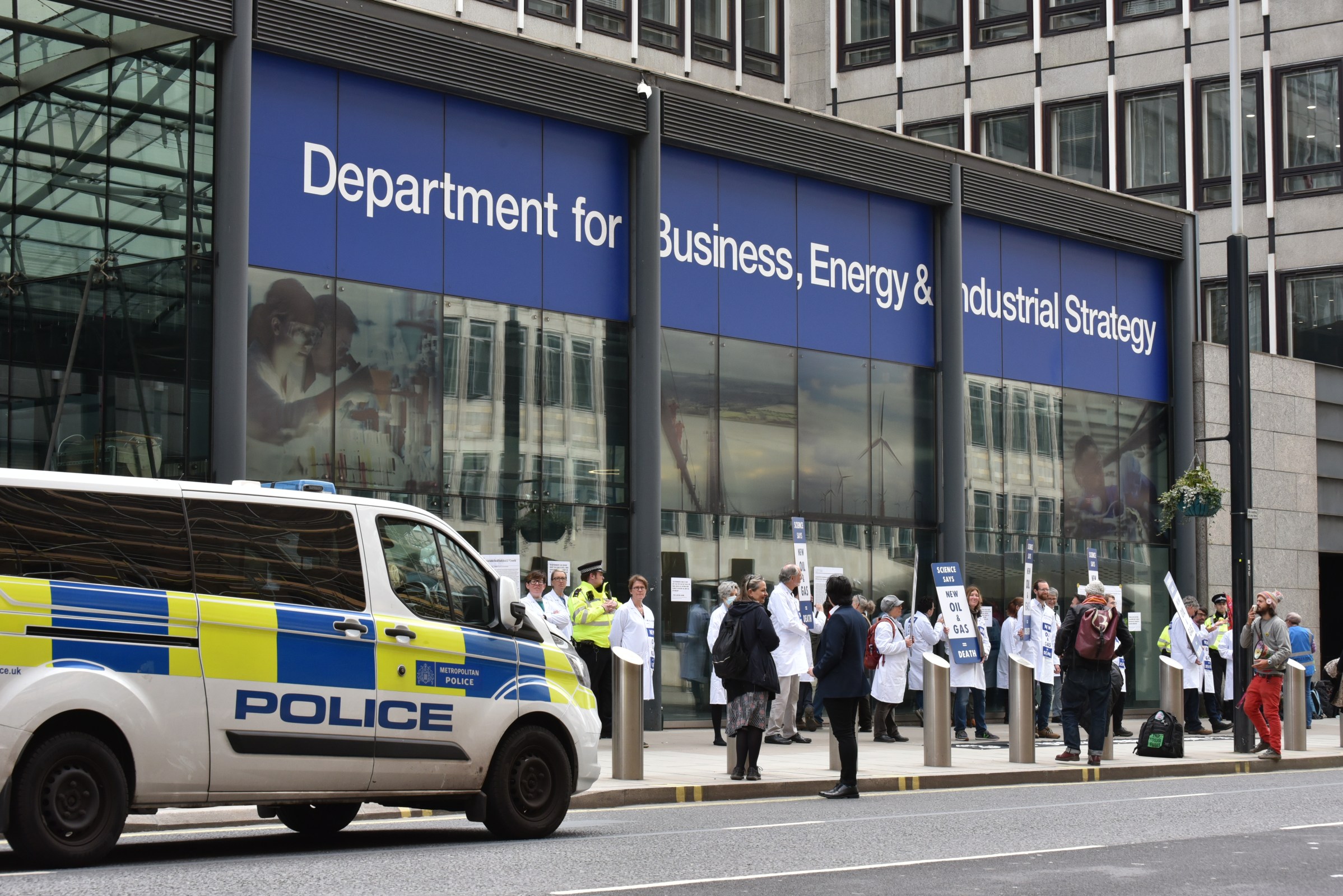
We sit down with Dr. Sam Finnerty regarding his research into the “Scientist’s Dilemma in Climate Activism” – how scientists manage the potential identity tensions that arise from their involvement in climate activism and advocacy.
Sam, could you briefly introduce yourself?

My name is Samuel Finnerty. I am a Wellcome Trust funded Senior Research Associate at Lancaster University. My academic journey began in social and cultural anthropology with a degree and master’s at Maynooth University, followed by a master’s in cognitive science at University College Dublin. I then undertook a PhD in social psychology at Lancaster University under the supervision of Mark Levine and Jared Piazza. My research initially explored the intersection of scientists’ identities and environmental activism but has since extended to examining how higher education institutions themselves are responding to the climate and ecological crises. Beyond academia, I’m engaged in climate action, continually reflecting on the roles scientists and institutions play during this critical moment.
You recently investigated the topic of the scientist’s dilemma in climate activism. What is ‘the scientist’s dilemma’, and how does it relate to scientists’ involvement in activism?
The scientist’s dilemma arises from the tension between traditional scientific norms—objectivity, impartiality—and the moral urgency of the climate crisis. Scientists are essential to understanding and tackling the crisis, yet many struggle with balancing professional expectations and public action. On the one hand, scientists are expected to maintain their credibility as neutral observers; on the other, some feel a moral responsibility to ensure their findings lead to societal change. This dilemma often forces scientists to navigate competing imperatives: should they remain distant and neutral, or actively advocate for solutions based on their expertise?
In other work, you found that scientists who see their scientist and activist identities as compatible engage more in activism. Can you tell us a little about that work and what you found?
Our Nature Communications Earth and Environment paper demonstrated that the content of a scientist’s identity—how they perceive the relationship between science and activism—significantly predicted their engagement in activism. Scientists who viewed advocacy as compatible with scientific objectivity and saw environmental stewardship as a moral duty were more likely to participate in action. This same group of scientists was also less inclined to endorse techno-solutionism, a perspective that emphasises future technological solutions, while downplaying the need for systemic and political change. These findings underscore the importance of “inter-identity fit”, as scientists who align their values with activism are more willing to engage meaningfully in addressing the climate crisis.

Does your work suggest that certain individuals are more likely to struggle with the scientist’s dilemma than others?
Yes, certain groups of scientists are more likely to experience this dilemma. The traditional conception of scientists as impartial and apolitical—rooted in scientific norms of objectivity and detachment—can deter engagement for those who strongly adhere to these values. Such conceptions are often reinforced through professional norms, institutional cultures, and concerns about credibility or polarisation. However, many scientists challenge this traditional model, arguing that remaining “neutral” in the face of the climate crisis is morally and intellectually untenable. These tensions reflect diverse scientist identity constructions that can either hinder or enable action.
In your recent paper, you interviewed scientists from several countries and found that scientists confront and wrestle with the scientist’s dilemma using two different repertoires: By “reconceptualising scientist identity” and “reframing the work that scientists do”. Can you briefly explain what those repertoires involve?
In our paper, we found that scientists manage the “scientist’s dilemma” through two broad approaches. First, some challenge or reinterpret traditional views of what it means to be a scientist, aligning activism with their professional identity. For example, they may emphasise a moral duty to act, arguing that expertise creates an ethical responsibility to engage, or frame activism as a logical and objective response to scientific evidence – an extension of their role rather than a departure from it. Others reject the notion of “pure objectivity” altogether, suggesting that acknowledging personal values can lead to greater transparency and stronger scientific integrity.

For those less comfortable with activism, the focus shifts to their professional roles. They channel their efforts into research, teaching, and public communication, reframing these activities as deliberate forms of advocacy. Some carefully distinguish their engagement as “advocacy” rather than “activism”, reflecting concerns about credibility or professional norms while still contributing to change.
Ultimately, these different approaches illustrate the creative and strategic ways scientists resolve the dilemma, allowing them to engage with the climate crisis in ways that align with both their values and their professional identities.
Do you have a favourite quote from your interviews with scientists? Why is it your favourite?
One of my favourite quotes comes from an ecologist who captured the urgency and unique responsibility of scientists:
“I’m not just any scientist, I’m an earth scientist. I specifically know about what’s happening to the planet and […] my knowledge compels me to act […] because […] I worry that there might be people out there thinking “well, if it was really that bad then the scientists would be freaking out.” So, I think it’s important that we act like it’s an emergency […] it’s important that scientists are visibly freaking out.”
I find this quote particularly compelling because it highlights why many scientists feel driven to act publicly. If scientists appear calm and detached, the public may fail to grasp the scale and urgency of the crisis. For this ecologist, visible action is not just about raising awareness—it’s about embodying the seriousness of the situation and demonstrating that the climate crisis demands an immediate, collective response.
Your most recent work explored how scientists talk about the future in the context of the climate crisis. What did you find, and why does it matter?
We found that scientists talk about the future in very different ways. Some insist that societal collapse is inevitable, which often reflects a deep frustration about the scale of the crisis. Others see collapse as delay-able, but only if we act urgently. Then, there are those who focus on transformation, framing the future as something that can still be reshaped through human action.
What struck me was how these ways of talking about the future influence not just how scientists see their role, but also the kinds of solutions they argue for—whether it’s prepping for societal collapse, engaging in civil disobedience or collective action, or investing in technological innovation. Scientists aren’t just producing knowledge; they’re shaping how society imagines what is possible, which can make a real difference in how people think about and respond to the climate crisis.
You are a scientist yourself (a psychologist), and an activist. How has this informed the work that you are doing and your approach?

Being both a social psychologist and an activist provides me with a dual perspective. As a psychologist, I study how identities, norms, and values shape behaviour—key factors in understanding scientists’ engagement with activism. As an ethnographer actively involved in climate action, I’ve experienced firsthand the tensions I research, such as balancing professional credibility with moral responsibility. This combination allows me to approach the work with both critical insight and empathy, understanding how scientists navigate these challenges in their own lives.
What are some take-aways from your work that you would like all scientists on the fence about activism to know?
Activism doesn’t have to mean civil disobedience or public protest—there are many ways for scientists to advocate for change. This could involve reframing your research to address pressing environmental challenges, using your expertise to educate and engage the public, or influencing policy through outreach and communication. Importantly, activism and scientific objectivity are not mutually exclusive. Many scientists see advocacy as a natural extension of their role: using knowledge to inform action is part of what it means to be a scientist.
Finally, the urgency of the climate crisis prompts reflection. Choosing to remain silent or inactive is, in itself, a decision with consequences. For many scientists, advocacy and activism provides a way to reconcile their expertise with their sense of moral responsibility, ensuring their work contributes meaningfully to addressing the climate emergency.
If you would like to get in touch with Sam, he can be reached by email at s.finnerty [at] lancaster.ac.uk
You can also follow Sam on social media here: https://bsky.app/profile/samuelfinnerty.bsky.social
Interview questions and blog by Jared Piazza

Cover photo credit by: Andrea Domeniconi/Alamy Live News
 PHAIR Society