
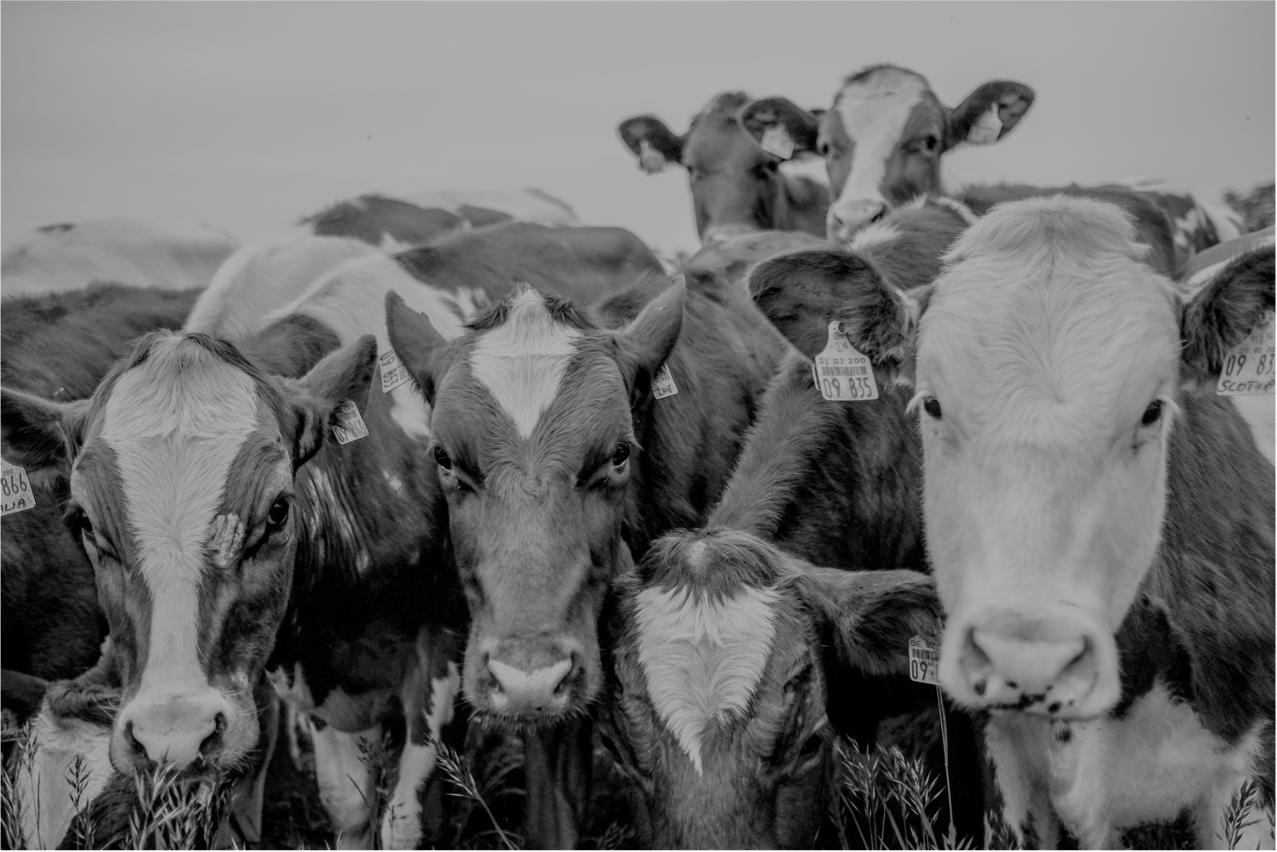
For this week’s PHAIR blog, we are continuing our theme of dairy consumption – looking at psychological research that moves beyond the usual focus on meat consumption. I had a chat with Chelsea Davies and Samantha Stanley about their recent paper, “Untangling the dairy paradox: How vegetarians experience and navigate the cognitive dissonance aroused by their dairy consumption,” published in the journal Appetite. The paper explores whether vegetarians experience cognitive dissonance about consuming dairy products and, if so, what are the psychological consequences of these conflictual feelings – for example, do vegetarians rationalise their dairy consumption much like omnivores rationalise their meat consumption? Here’s what they had to say.

Chelsea and Samantha, could you each briefly introduce yourself?
My name is Chelsea Davies, and I am a Clinical Psychology Masters student at the University of Canberra in Australia. I first completed my honours degree in psychology at The Australian National University where I worked with Dr Samantha Stanley. Here, using a social psychological framework, we channelled our mutual interest in the negative impacts of the meat and dairy industry to guide our research. Specifically, we noticed there wasn’t much research on the psychology and rationalisation of dairy consumption, despite the theoretical and practical parallels to meat consumption (e.g., the impact on personal health, the animal, and the environment). I hope to continue exploring this field of social-environmental psychological research by integrating my clinical-based interests in the future.

I’m Dr Samantha Stanley and I’m a research fellow at the Institute for Climate Risk & Response at the University of New South Wales in Australia. In my work, I apply research and theory from social psychology to try to better understand the way that people think, feel, and act, in relation to climate change. My current role is funded by an Australian Research Council Early Career Fellowship and focuses on public attitudes towards policies that would support those most affected by climate change (e.g., resettlement for those at risk of displacement, compensation for Loss & Damage). I also have a strong personal interest in animal welfare and caring for the environment, which has shaped my research on the psychology of meat consumption and abstention.
Your new paper, “Untangling the dairy paradox”, extends work on the meat paradox to dairy consumption. Could you briefly summarise what the research was about and what you found.
In this paper, we aimed to test whether vegetarians experience cognitive dissonance about their dairy consumption. We had vegetarian participants complete an online survey about their motivations for being vegetarian and tell us about their recent dairy consumption. Then, we had half of them read about the ways that the dairy industry is harmful to animals, the environment, and human health. We found that those who read this message felt more guilty about their dairy consumption relative to those who did not read it, suggesting it induced cognitive dissonance. We wanted to know what vegetarians did with this cognitive dissonance – for example, would they ‘explain away’ or rationalise their dairy consumption as Natural, Necessary, Normal, and Nice (as found in meat-based research)? Interestingly, we found that, if anything, vegetarians were less likely to justify their dairy consumption, and more likely to contemplate reducing how much dairy they eat.
We found that, if anything, vegetarians were less likely to justify their dairy consumption, and more likely to contemplate reducing how much dairy they eat.
Work that has examined common arguments that meat eaters provide to defend meat consumption relate to four “N” categories: Necessary, Normal, Natural, and Nice. Your research suggests a fifth “N” applies to dairy justifications. What is that fifth “N” and how is it used to justify dairy consumption?

Chelsea had read widely on the 4Ns that justify meat consumption (and we are big fans of Jared’s work on this!). She found a Masters thesis by Sarah Kunze that uncovered a fifth “N”, Neglectable, in the context of dairy consumption. In this research, Sarah interviewed people in focus groups to hear about their justifications for consuming dairy. In doing so, she found some similar justifications that Jared and his colleagues found in relation to meat (e.g., that dairy is Normal to eat). But she also found a new category of justifications that seemed unique to dairy consumption. This fifth “N” (Neglectable) is used to justify dairy consumption by framing it as: (a) innocuous compared to meat (e.g., “Eating dairy products is better than eating other animal products”) and (b) so embedded in the food system that it’s unrealistic for people to completely cut it out (e.g., “Dairy products are too hard to avoid”). These examples are items in the scale we developed to measure the fifth “N”.
One surprising finding was that vegetarians who read about the environmental, animal welfare, and health issues linked to dairy defended dairy consumption on certain dimensions (e.g., its Naturalness) less than those who did not read about these issues. This is the opposite of what should occur if vegetarians were experiencing dissonance about their dairy consumption and were motivated to defend it. What does this result suggest about how vegetarians respond to potentially dissonance-arousing information about dairy?
In the cognitive dissonance literature, there are different avenues people can take to alleviate dissonance. Behaviour change isn’t a common route, especially for enjoyable behaviours like eating. A more common route is to justify one’s current behaviour, such as saying a food is too nice to give up (have you ever heard someone say they can’t go vegan because they love cheese too much?). Our results suggest that vegetarians in our sample did not try to alleviate cognitive dissonance by justifying their dairy consumption. Instead, they were more likely to acknowledge the problems with eating dairy by rating dairy consumption as less Natural and less Neglectable, and rating cows as having greater agency, when experiencing guilt about their consumption. Social identity theory offers one explanation for our unexpected finding. It is possible that when vegetarians in our sample read that dairy is equally as harmful to the environment, animals, and their bodies as meat, this threatened their sense of self. Then, to protect their identity as a value-conscious eater, they did not try to justify or defend their choice to eat dairy, and, instead, stated that they intended to reduce how much dairy they consume. Unfortunately, we didn’t have funds for a follow-up study to measure actual behaviour change, so we have no way to know if they followed through on this intention.
As a vegan, I find it easier to justify consuming dairy than meat. Indeed, it somehow “feels” less bad to consume an entire cheese pizza than a single pepperoni on a cheese pizza, even though I know that’s not true for the animals involved. Does your research into the dairy paradox help explain these irrational feelings I have about consuming dairy vs. meat?
This sounds like textbook “Neglectable” rationalising! We would hypothesise that it’s even easier to justify more ‘invisible’ ingredients too, like milk powder hidden in otherwise plant-based foods. We didn’t ask participants about their meat consumption or attitudes towards eating meat, but there are a few findings that are relevant here. Our cognitive dissonance induction reduced perceptions of dairy as Neglectable, which was associated with retaining higher levels of cognitive dissonance over time. In other words, seeing dairy as more Neglectable could help feelings of guilt pass. Perceiving dairy as a Neglectable food item could give people some protection from these guilty feelings when they hear about the negative aspects of the dairy industry. We also found a positive correlation between dairy consumption and Neglectable scores. This suggests that people who eat more dairy products also tend to see this behaviour as more Neglectable, so perhaps seeing dairy in this way helps vegetarians to keep eating cheese pizzas.
Cognitive dissonance is a powerful emotional state that can strengthen or change a behaviour.
What would you like vegan and animal advocates to take away from your research, and apply to their advocacy work?
One of the reasons we think our experiment led to behaviour change intentions rather than strengthening justifications for continuing to eat dairy is that we had participants commit to their vegetarian values (by telling us why they don’t eat meat) and report on their recent dairy consumption. This way, our experimental manipulation made the disconnect between their stated values and their behaviour very clear. Vegan and animal advocates could apply this in a few ways. The first is to consider tailoring their advocacy efforts to their audience. Vegetarians might respond differently to appeals to reduce their dairy consumption than meat eaters would to the same messaging. The second is to consider leveraging the reasons vegetarians give for abstaining from meat when explaining the problems with the dairy industry. For example, someone who has committed to abstaining from beef because they care deeply about cows might be more persuaded to change their dairy consumption if they are walked through the ways the dairy industry harms cows. Cognitive dissonance is a powerful emotional state that can strengthen or change a behaviour. Our research points to the importance of studying this process specifically within vegetarian samples and for dairy consumption, so that appeals can be tailored to the audience and the behaviour we’re hoping to change.
If you would like to get in touch with Chelsea and Samantha about their research: You can reach Chelsea by email at davies.a.chelsea@gmail.com and Samantha at s.stanley@unsw.edu.au
Interview and blog post by Jared Piazza

Cover photo by Hans Ripa
If you would like to read more about the ‘Dairy Paradox’ and the research discussed in this interview, please check out:
Davies, C. A., & Stanley, S. K. (2024). Untangling the dairy paradox: How vegetarians experience and navigate the cognitive dissonance aroused by their dairy consumption. Appetite, 203, 107692. https://doi.org/10.1016/j.appet.2024.107692
 PHAIR Society