

Is participating in the app-based Veggie Challenge effective for reducing animal product consumption? And would it help to involve family and friends? Rosaly Severijns discusses the key findings and insights from her recently published research ‘Involving family and friends helps sustainable diets last longer’.
Could you give us a brief introduction about who you are and what you do, Rosaly?

I am a researcher interested in anything that has to do with climate beliefs and behaviours. During my PhD I studied how our social environment, so our family and friends, influences our consumption of meat and other animal products. The people around us play an important role in our decisions and habits. I recently started a postdoc at the University of Antwerp (Belgium) during which I hope to continue working on psychological and social processes behind meat consumption and other climate or health-related beliefs and behaviours. In my free time, I like to sing, read and travel 😊.
In your recently published research ‘Involving family and friends helps sustainable diets last longer’, you investigated the effects of the Veggie Challenge campaign. Can you briefly explain what the Veggie Challenge is and how you studied its impact?
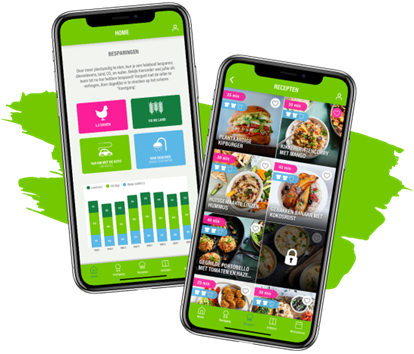
The Veggie Challenge is a campaign organized by the non-profit organization ProVeg International. During the challenge, people try to eat fewer animal products for 30 days with the support of an app. They can choose their own goal during the 30 days: start with meatless days or try a vegetarian or vegan diet. In the app they can find recipes and information about plant-based diets. They can also keep track of their behaviour (for instance, whether they succeeded at skipping a certain product or not), and receive feedback on how much land, water, emissions, and how many animals they are saving by eating a more plant-based diet. The app looks colourful and has gamification features, like quiz questions and rewards if you do well. In an extension of the app (Veggie Challenge Teams), participants can invite family and friends to their team and do the challenge together. They have a shared WhatsApp group and can see group-level activities and feedback.
We studied the effects of the challenge through a randomized controlled experiment. This means that we recruited individuals (about 1,200) and randomly assigned them to one of three groups: a group that did not take part in the Veggie Challenge (control group), a group that participated alone in the Veggie Challenge (individual intervention group) or a group that participated in the Veggie Challenge and were asked to invite others digitally and/or involve others in real life (social intervention group). We tracked all the participants over time up to three months after the intervention and compared their animal product consumption.
What were the key findings?
Our key findings were that initially, right after the intervention, both the individual and the social group consumed fewer animal products than the control group, a reduction of about 16-17% in animal product consumption. However, one and three months after the intervention the individual group bounced back to similar levels as the control group, while the effect of the social intervention group persisted.
We also found that people who still ate meat before the intervention were affected the most by the intervention. In line with this, the veggie challenge worked best to reduce meat consumption (25% reduction) rather than other animal products.
People want to maintain a coherent identity towards others and themselves. So when they tell people about their plans to reduce their meat consumption, it becomes more salient in their minds and they want to live up to that expectation.
Why is the social environment (involving friends and/or family) so important for reducing animal product consumption?
In general, the people around us influence our daily behaviours and habits. In particular for food, what we eat every day is rooted in negotiations with family, friends, or colleagues. Food is also linked to social events such as going out for dinner, or celebrating birthdays and holidays (e.g., Christmas). Others can also influence our beliefs and awareness about food, for example about the environmental or health impacts of meat consumption.
When people are already motivated to reduce meat consumption, like in our study, the social environment can play an important supporting role. Because we are dependent on others we eat with, having a non-supportive environment could pose a barrier to translating motivations into behaviour. In our study, we aimed to overcome this barrier by stimulating participants in the social intervention group to create a supportive environment and establish habits together with family and friends. While the initial effects were not larger than for the individual intervention group, we suspect that this supportive environment made the behaviour change last longer.
Another reason why involving others is important, is that telling others about our behavior change process or involving them makes it more ‘real’. People want to maintain a coherent identity towards others and themselves. So when they tell people about their plans to reduce their meat consumption, it becomes more salient in their minds and they want to live up to that expectation.
How can participants in the Veggie Challenge involve more family members and friends?
One way is to participate together with others using the app (Veggie Challenge Teams). Because this requires some effort from others, this would mostly work with people who are also motivated to reduce meat consumption, for example like-minded friends. That is why in our study we also encouraged participants to involve people in real life. This can be as simple as striking up a conversation about it. At home this can be done by telling household members about the challenge, about the plant-based/vegetarian meals you are eating, or even making them try those meals. One can also try to share recipes, struggles or thoughts about eating less animal products with friends or other acquaintances. People in our study reported that merely sharing their struggles or wins with others during the challenge made them more motivated.
The study only included individuals who already had an intention to reduce animal product consumption. Why did you decide to focus on this target group? Would you expect different results among people, especially omnivores, who are not initially interested?
That’s a good point. We focused on people with an intention to resemble real-life Veggie Challenge participants. In order for people to put the effort into starting such a challenge, they already need to have some motivation. I am not entirely sure about the possible results among less interested omnivores. On the one hand, there is a lot of room for them to eat fewer animal products, so even a small reduction due to the Veggie Challenge would be good. On the other hand, a lack of motivation may make people less inclined to download and continue with the app in the first place.
Regardless of the type of behaviour, challenges are better suited for individuals who are at least somewhat motivated. For people who lack motivation, an intervention that sparks initial motivation would be more suitable. This could be providing information on the impacts, appealing to emotions, encouraging discussions with motivated people, or changing the choice environment to introduce new habits (e.g., only offering plant-based meals or making those the cheapest, most logical options).
For this research project, you collaborated with a non-profit organization in the Netherlands (ProVeg Nederland). How did this collaboration start and how was this experience?
The collaboration started because I contacted them at the start of my PhD. I wanted to put my research in a real-life context and they happened to be looking for someone to study their Veggie Challenge. That’s how it became one of my PhD projects. I mostly worked with Pablo Moleman, who is in charge of research conducted at ProVeg Nederland. Our collaboration always went smoothly.
What are the key benefits of this collaboration?
The key benefit from a researcher’s point of view is the possibility to assess an impactful campaign that’s already publicly available. This increases the practical relevance of the research. Any person can download the Veggie Challenge right now. Rather than a hypothetical setting, the research is more applicable to real life.
Apart from that, a collaboration like this is beneficial to both sides: ProVeg wanted a robust experiment to test their campaign, but they did not have the time or resources for it. We at Hasselt University wanted to study practically relevant interventions and had the time and resources to do so. I would really recommend researchers to find collaborations with advocates or partners in the field.
Did you experience any significant challenges of working with an advocacy organization?
We did not run into any major issues. If I had to mention one thing, it would be that sometimes it was difficult to align practical goals with a strong research design. For example, for ProVeg it would have been ideal to know exactly what the effect is of participating in Veggie Challenge (Teams). However, a strong research design requires randomizing people into the groups, so they could not self-select in downloading the app and participating. Therefore, the intervention was an ‘encouragement’ to participate rather than actual participation. Luckily, ProVeg was always very open and flexible towards my research design recommendations.
In summary, uniting the research goals with the goals of an advocacy partner can take some time, but it is worth it.
What can organizations, food/vegan advocates, or policymakers learn from this research?
The main takeaway is that the social environment plays an important role in whether behaviour change happens and lasts. In our research, a quite simple encouragement to involve others already made the change last longer. It should be easy to implement this in other behaviour change campaigns. For example, an information campaign can easily include tips on how to seek support from others.
On a larger scale, I think behaviour change interventions are too often focused on individual behaviour change, ignoring that the social environment can be a huge barrier (or facilitator). Researchers and advocates should find ways to take this into account and overcome the barriers.
If you would like to get in touch with Rosaly, connect with her LinkedIn: https://www.linkedin.com/in/rosaly-severijns-phd-a4a119b4/
Cover photo credit: ProVeg
Interview and blog post by Georgia Harlow and Mia Patel. Editorial supervision by Kristof Dhont.


 PHAIR Society